

Today I bring another recent vintage find. It is an odd book that I adore and it makes me chuckle and I’m not quite sure I completely understand it. So I keep reading it and delighting in it and isn’t that the point of books anyway? This is definitely an odd choice of book for Ash Wednesday, but there are not many books I would consider fitting for Ash Wednesday and this one actually feels a little fitting. Come have a look at The Mouse and the Egg by William Mayne, illustrations by Krystyna Turska, 1980.
(As it is vintage, I will share more of it than I do with new books since it is unlikely you will find a copy easily.)
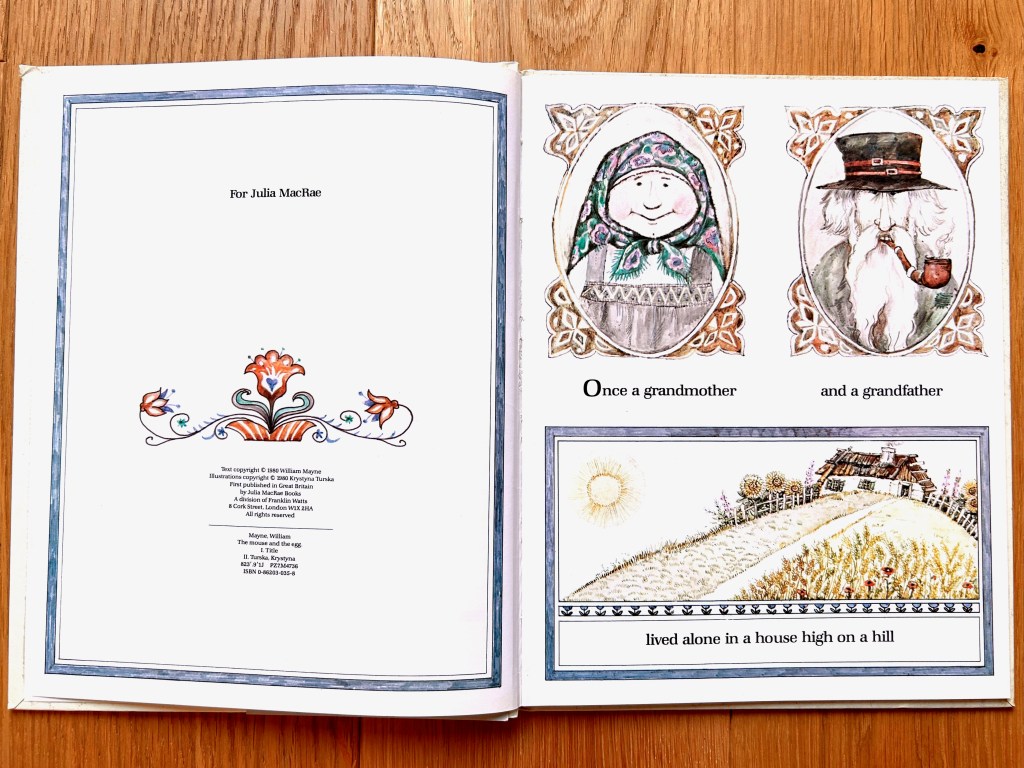
The story opens with a glimpse of a grandmother wearing a scarf on her head and a grandfather with a hat and a large pipe. We are told they live “alone in a house high on a hill.” The house looks modest, but charming seated high on that hill with sunflowers blooming around it and the sun shining brightly over it all.
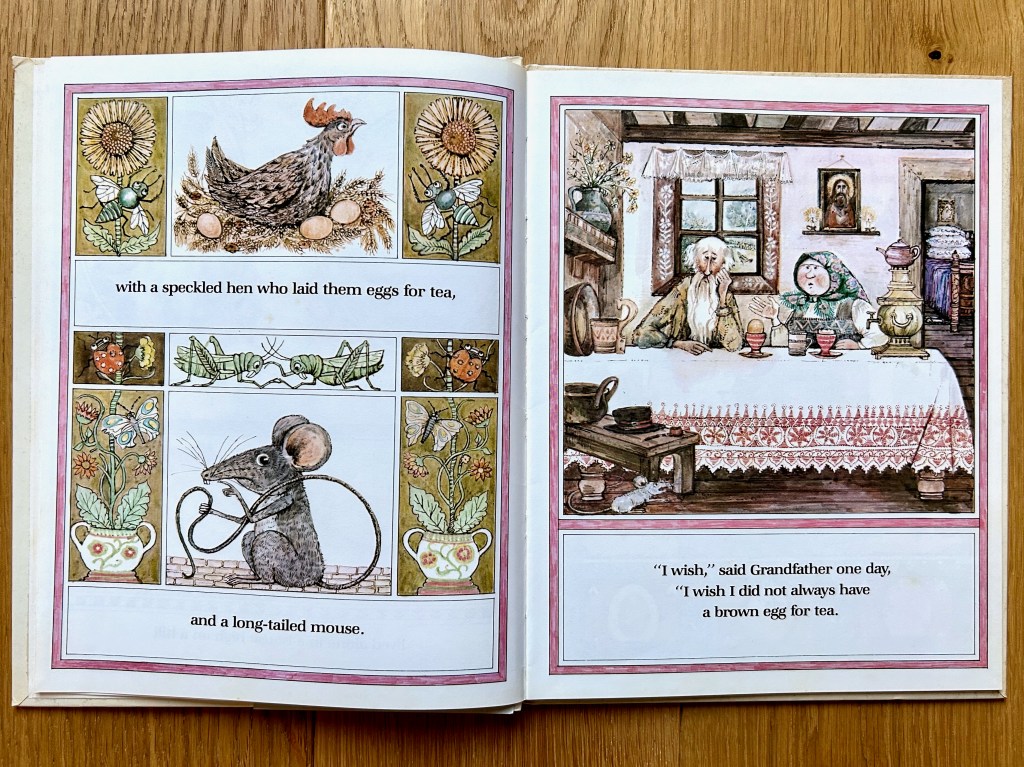
Though we are told they live alone, we are next told that they live with a speckled hen who laid them eggs for tea and a long-tailed mouse. It is a very long tail. He looks mischievous. And there is definitely something up with the mouse. But we should know that since he is in the title of the book.
I’m going to stop here to go ahead and already talk about the illustrations. They are the star of this book without a doubt. The style is stunning and caught me from the very first page of the book. It has a vintage vibe, and a muted palette which I think is intentional; but also feels very indicative of painting in watercolors that are never quite as saturated as acrylics or gouache. This page already speaks to the reason I grabbed this book: the decorative framing of the illustrations. Fascinating. You could be silly and skim over them as merely fun decorations, and perhaps they are, but you miss a lot of the delight in this book if you skip them. Just like a thoughtfully decorated house makes you feel cosy and shows a deeper story of the family who lives there; the decorations here seem to do the same. They don’t necessarily tell any part of the story, but they are lovely and stories in themselves and add depth to the pages and the story. They remind me a bit of Jan Brett books, but I’ve never adored her use of these decorative frames as much as I delight in these. (Sorry to Brett fans.)
On the right page, the story has moved past introduction of the key players and we have a bit of a record scratching moment. The grandfather declares one day that he wishes he did not always have a brown egg for tea. Cue ominous music or uncomfortable silence, whichever you imagine.
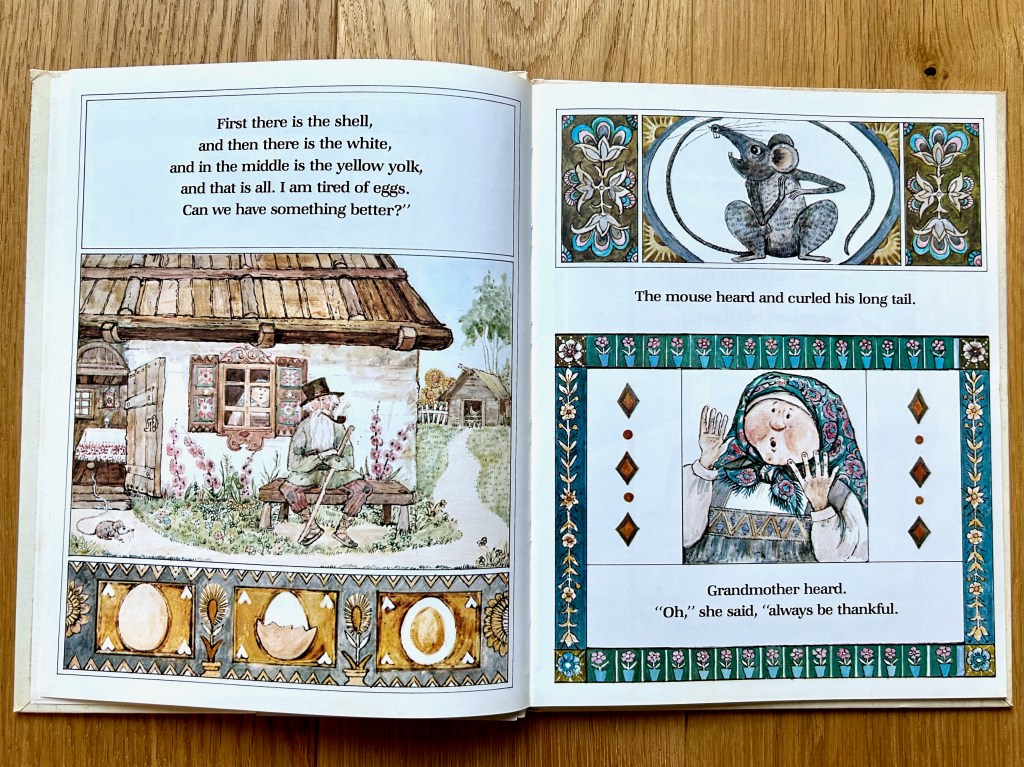
He goes on to explain his complaint that there is the shell, the white and the middle yellow yolk. That is all. He is tired of eggs and wants something better. Underneath his clear pouting pose on a bench with his pipe, we have a panel showing the egg in its three apparently offending parts. I’ve never admired an illustration of an egg so much. I would frame that in my kitchen; it is so lovely.
Well, the mouse is horrified and curls his long tail over himself.
Grandmother is also aghast and exclaims that you should always be thankful.
(Sidenote: My girls frequently binge episodes of The Story Pirates podcast and it is a common occurrence that something happens and all the pirates gasp, but one of the pirates actually says the word “gasp.” Every time I hit this page, I hear that in my head.)
I think this moment is actually key in the book, as understated and early on in the story as it falls. There is not much explanation for what next occurs and we have to wait for the circle back moment even as it isn’t explained. Stay tuned.
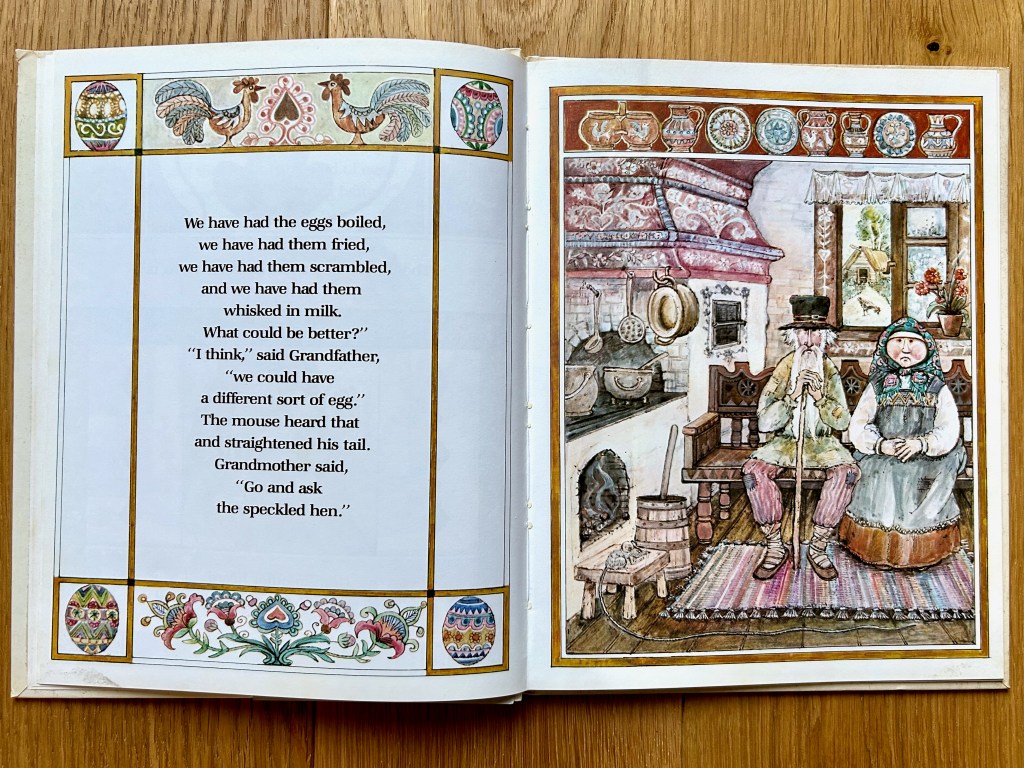
The grandmother then attempts to list all the ways that she, though she says “we,” has made the eggs for them to enjoy in the past. What could possibly be better? I want to read this moment in an exasperated tone, but she looks too sweet and seems more incredulous and worried at ungratefulness in general than not directed towards herself. I also love that this text is framed by gorgeously decorated eggs and fantastically plumed hens. Don’t skip the decorative frames!
The grandfather thinks they could have a different sort of egg. “The mouse heard that and straightened his tail.” It is an incredibly long (longer than it was previously?) tail. I have no explanation here. Just stick with me.
Behind the main image, you can just see the hen out in the garden unawares and pecking at the ground.
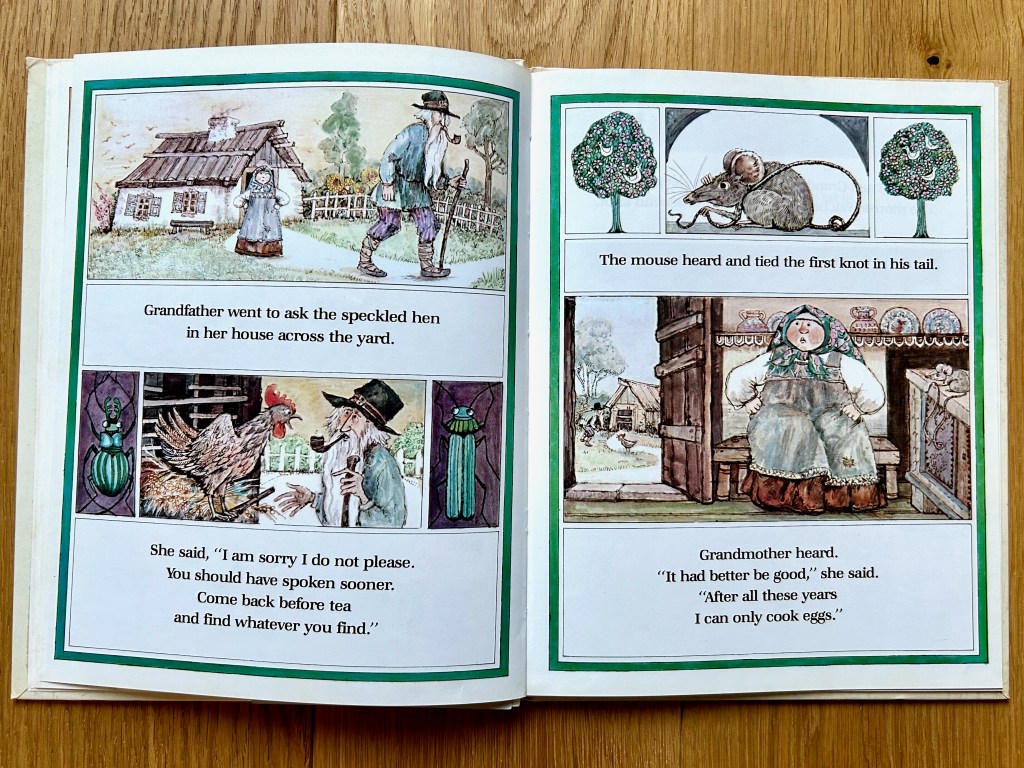
The grandmother has told the grandfather to go ask the speckled hen. So he does. The grandmother looks on with hands on her hips. Body language is everything.
The hen responds shockingly politely with an apology. This is very British. There is a common stereotype/joke/fact that British people apologize often and often unnecessarily. Perhaps it is also passive aggressive (both from the hen and British people…) The hen apologizes that she does not please. Says he should have said something sooner. And she invites him to “come back before tea and find whatever you find.” I think we need to insert some ominous music here too. Dun dun duuuun!
From the right side of the spread, you see the mouse cowering or hiding, looking clearly embarrassed for the grandfather and them all apparently. And we are told he ties “the first knot” in his tail. What is happening? Is this the British equivalent of a “strike one” that we would say in America? I have so many questions.
The grandmother can also be seen on the right side, still with hands on hips; but she has moved behind the house door and is possibly hiding inside the house out of sight of the hen and this embarrassing situation. She heard the conversation and expresses concern that hopefully whatever he finds will be good because she doesn’t know how to cook anything but eggs after all these years. I can’t help but giggle.
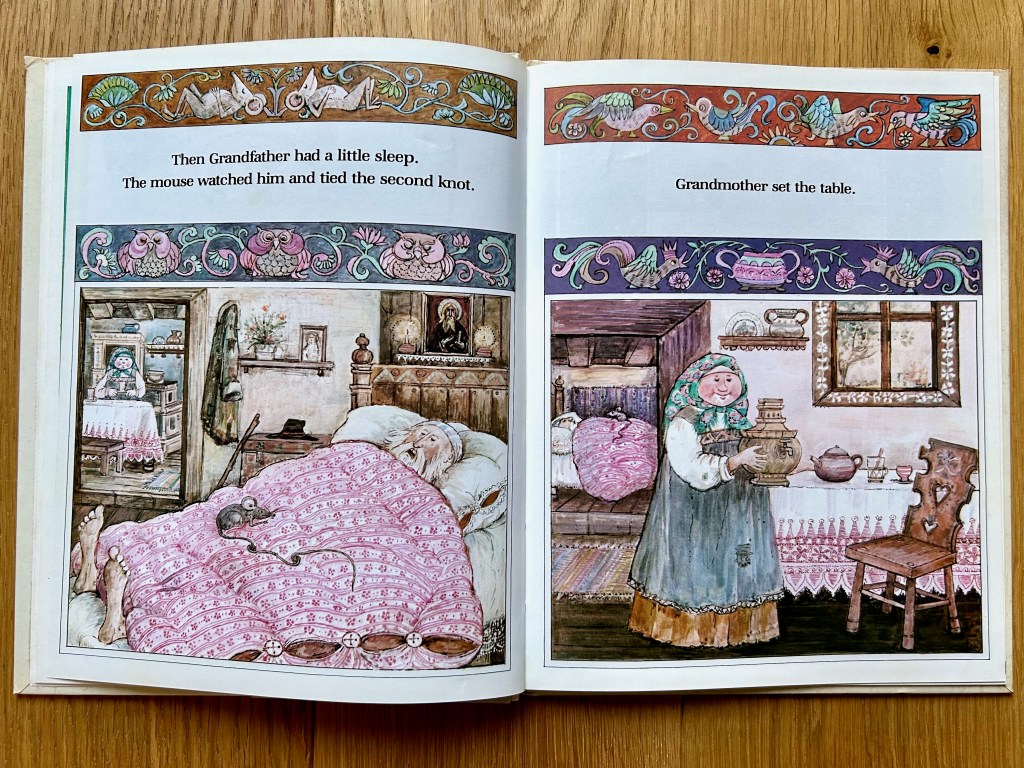
Next up, Grandfather had a little sleep. The mouse is sitting on his tummy watching him sleep and “tied the second knot.” I really do think we are talking about a “strike 1, 2, 3” situation here. I hadn’t realized that until I sat to write this review. I reread the book aloud before beginning my review and was still pondering the meaning of the knots. But I’m pretty sure that is what is happening. I have no other reference to use but an American “3 strikes and you’re out” terminology which obviously would make no sense in a baseball-less culture like the UK. I cannot find any British explanation for the knot tying situation in my quick googling research but I am going to have to figure out a way to ask if this is a thing and where it comes from. How fascinating! A new layer to the book that I hadn’t discovered yet. See, this is why I come to discuss picture books here. No one else would hash out this book with me and help me come to these thoughts and conclusions! But I digress. Back to our story.
Grandfather is napping after his complaints. The mouse is watching. And Grandmother is in the kitchen setting the table. I find the decorative borders in this one worth pondering. The top one, the mouse is also seen (in double!) sleeping. Hm…. Then there are three owls, one with open eyes and two with closed. Then there are four birds having a discussion or something. And finally 2 birds possibly wearing crowns squawking at a fancy bowl.
I would also like to pause and point out that part of the lovely decorations in the house around them has often included 2 paintings on shelves in the background. One in the kitchen, has been seen twice, with a man who has a saint icon around his head and there are two lit candles on the shelves around him. The other painting is in the bedroom above the head of the sleeping grandfather. It is a different man also with a saint icon and he is holding something in his hands. Two candles are lit on the shelves around him as well.
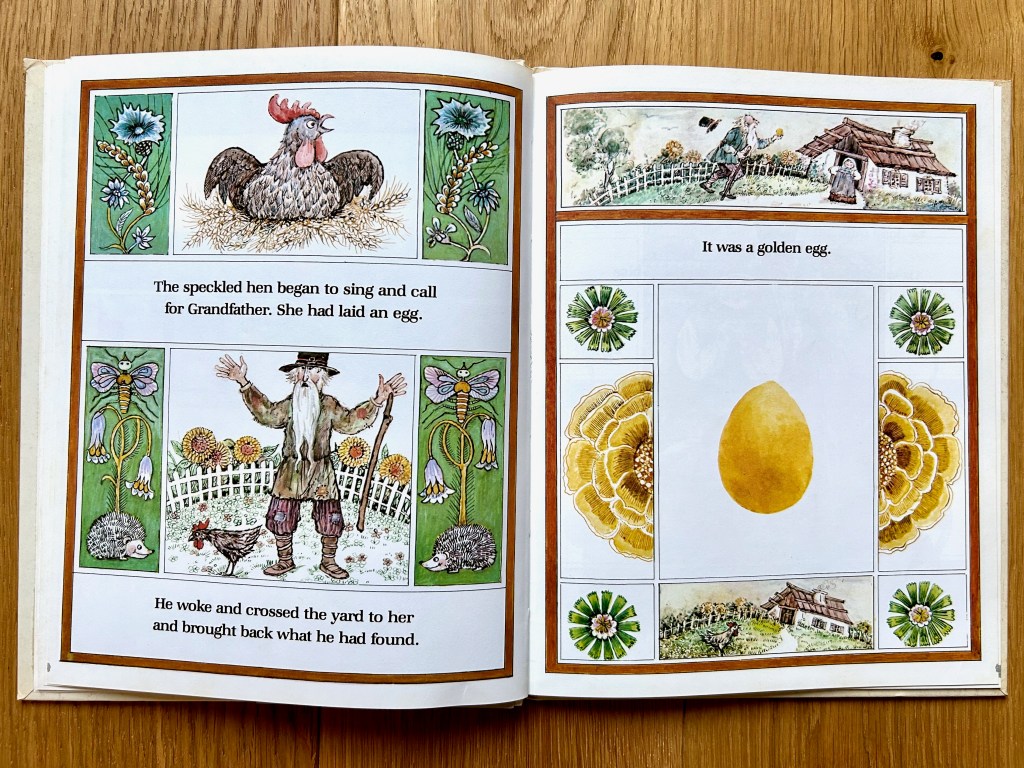
Next we have the speckled hen singing from her roost, calling for Grandfather. “She had laid an egg.” How kind of her. How curious. What is to come? Grandfather wakes and goes to bring back what he had found. Grandfather looks excited or surprised or something. Two hedgehogs appear in the decorative borders around him and maybe it is just me, but they look like they are smirking.
“It was a golden egg.”
The golden egg takes center of the page on the right. It is possibly actual size on the page. It is framed mostly by 4 (green?) flowers and one very large yellow flower that is divided by the egg’s box.
A long panel on the top of the page shows the grandfather running back to the house with the golden egg in hand. He is losing his hat in the process. The grandmother looks unimpressed with hands still on her hips.
The bottom smaller panel on the page shows the hen standing in the garden looking at the house which has a closed door. Hm….
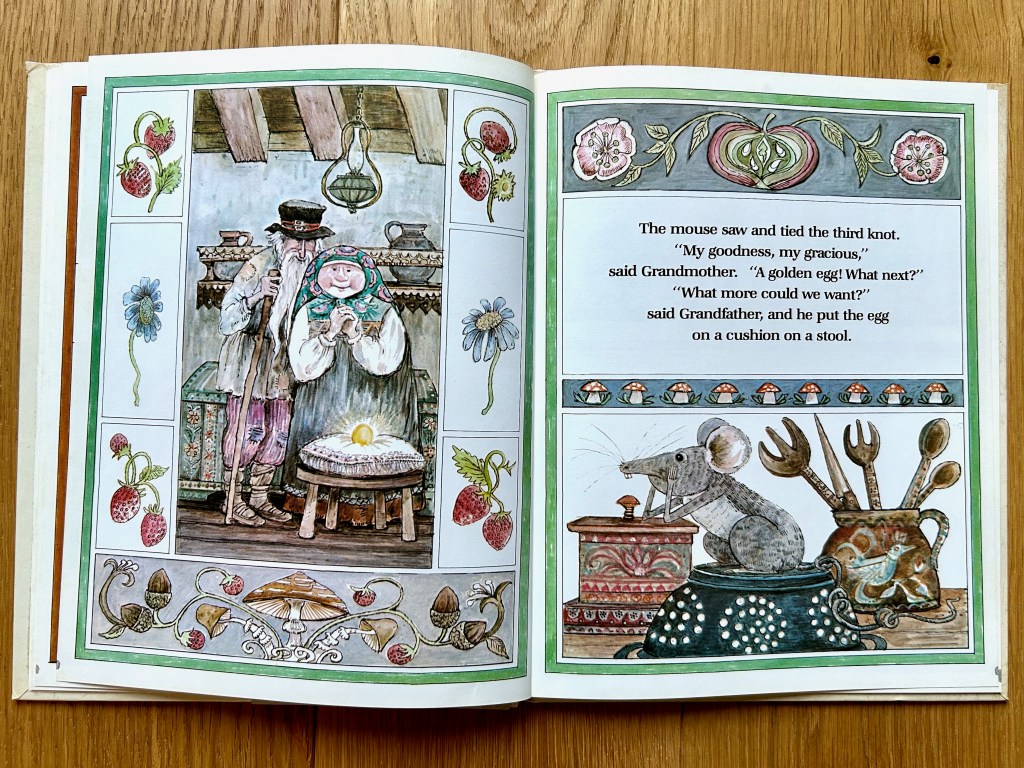
Now we have the grandfather (with recovered hat) and the grandmother with clasped hands looking down at the golden egg which they have placed on a cushion on a stool. The golden egg is glowing. The decorations around them are strawberries and flowers and a few mushrooms and acorns. No idea why. Abundance maybe? Deliciousness?
The mouse saw from the right page. He has tied the third knot. He is looking on a bit incredulously perhaps with his tiny paws holding his face and his elbows on a grinder. He is sitting on an overturned colander. Grandmother has exclaimed about the egg and asked “What next?”
And Grandfather says, “What more could we want?” He put the egg on the cushion and a stool.
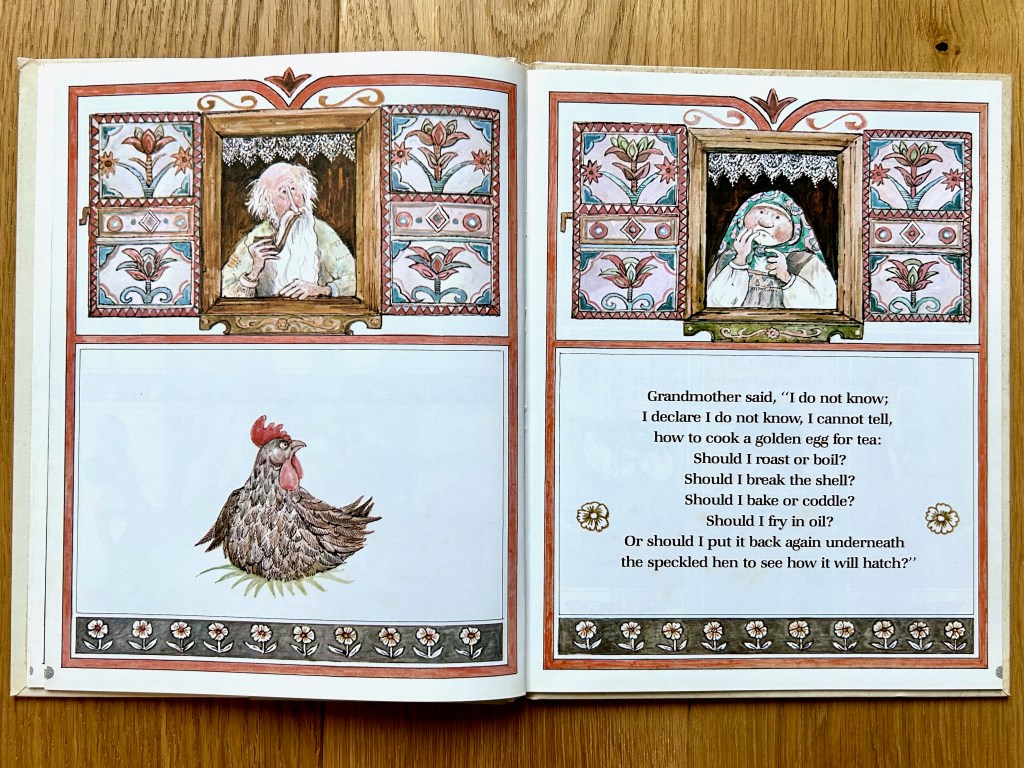
We have a great pause. From two separate, yet gorgeously decorated windows, the grandfather and grandmother look out. Both seem to be thinking. The grandfather has his pipe. The grandmother has her hands poised in thought. We see her thoughts in the text pondering how to cook a golden egg or if she should return it under the speckled hen to see how it will hatch.
The speckled hen sits in a startling white and undecorated space looking up towards the grandmother with an irate or disgruntled look if that is possible.
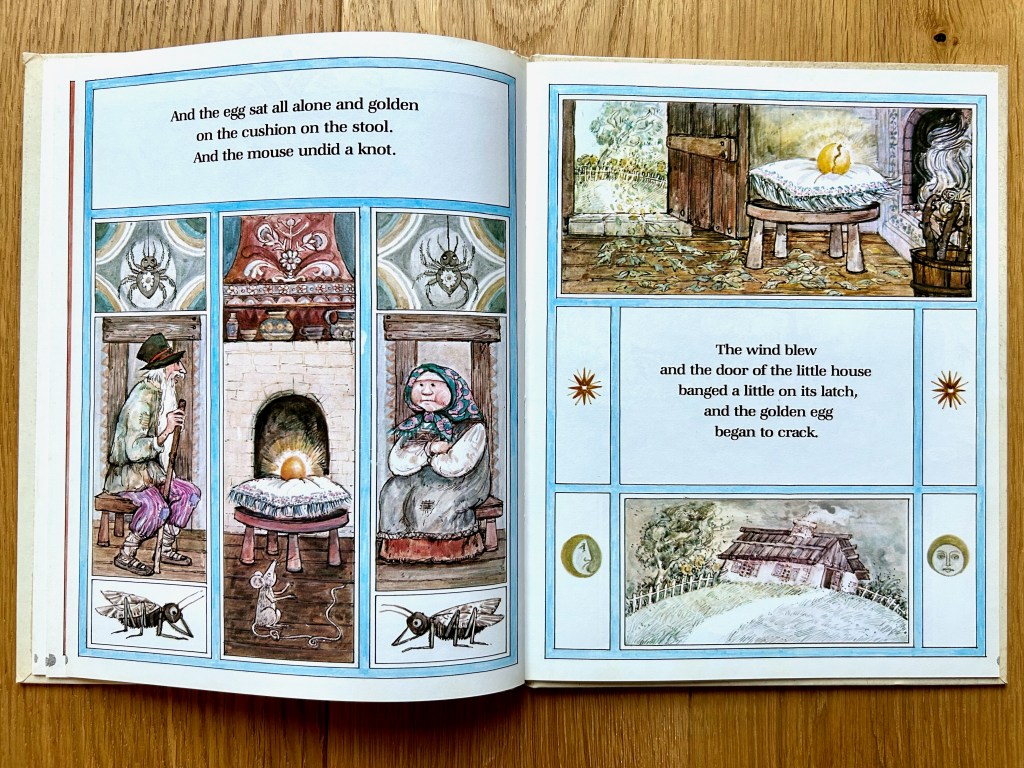
Here we have a triptych-type layout. Three main panels. The center one holding the golden egg glowing on the cushion on the stool. The grandfather and grandmother flank the egg on either side. The grandfather’s mouth is open, but no text comes from him. The grandmother has her arms crossed. Two spiders sit above the grandparents’ panels, rolling their eyes? And two grasshoppers sit under their panels looking annoyed, or bored.
The mouse sits within the center panel looking up at the golden egg. We are told “the egg sat all alone and golden on the cushion on the stool. And the mouse undid a knot.” I’m not sure why. There is no undoing strikes in the American saying. Something is undoing the knots. Is it because it is alone? Is it because they are perplexed? Is it because it is unused?
On the right page, the wind blew the door of the house open. The golden egg began to crack. We also see a vignette of the house with the trees blowing in the wind and the sky is darkening. The house is framed on either side by odd faces, one turned and looking dissatisfied at the house. The other looking out at the reader, breaking the fourth wall.
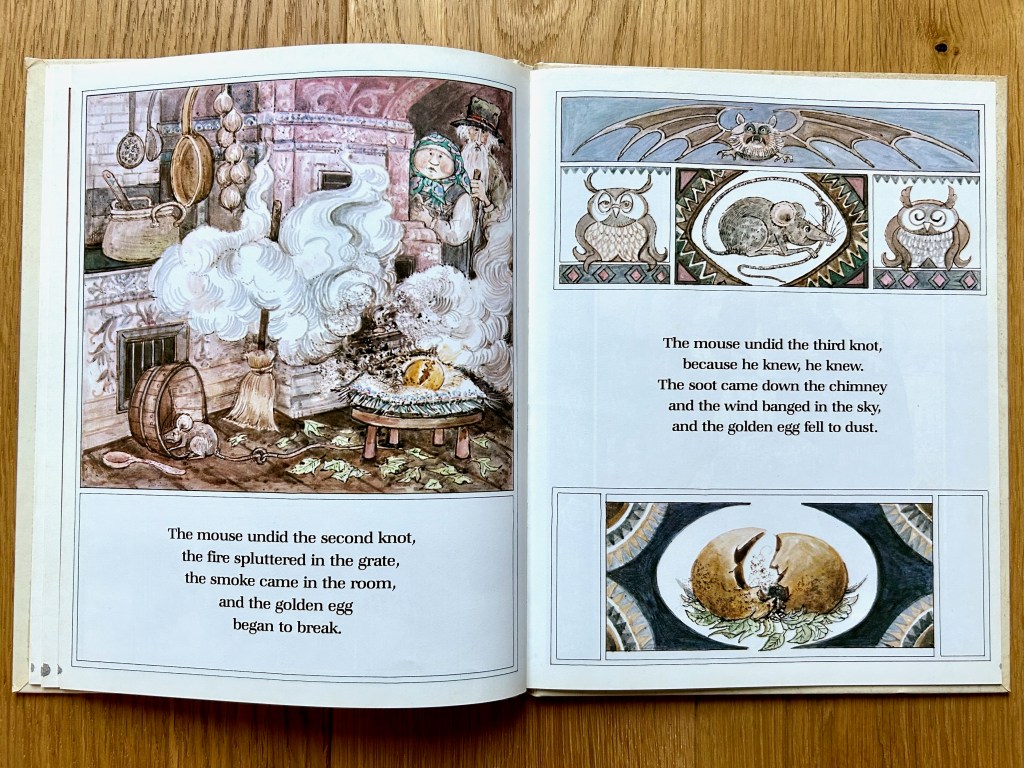
This page opens with “The mouse undid the second knot,” while the fire spits and smoke fills the room and the egg continues to break. We see the grandparents peering around the fireplace and the mouse is half hiding in a basket that has fallen to the ground. Leaves are all around the floor under the stool and ash is spilling onto the cushion and egg.
On the right page the mouse unties the third knot “because he knew, he knew.” What does he know?! At the top of the page a bat looks creepily out at the reader with its wings spread across the top of the page. Two owls flank each side of the mouse’s box, one owl looking out, the other with closed eyes and head downward. The mouse sits in the center almost smiling, holding his tail circled over him and unknotted. Is it almost over? He seems to think so.
At the bottom of the page, the golden egg sits now browned and cracked open with dust inside.
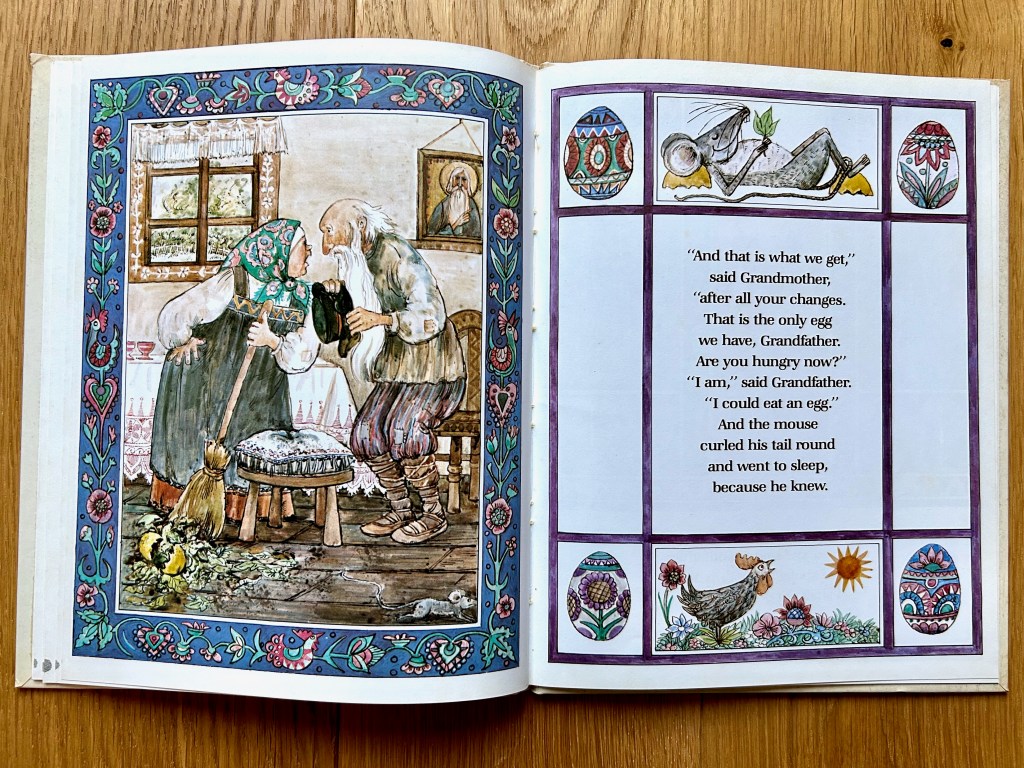
A large illustration fills the left page. The border is all around the page in blue with flowers and squawking hens and hearts. The grandmother holds a broom with one hand on her hip. She is turned with open mouth and furrowed brow clearly shouting at the grandfather. The grandfather looks at her very close to her face and looks sheepish, with his hat crumpled in his hands. The egg sits in a pile of ash and leaves on the floor. The mouse is running from the frame. And another saintly man is hanging on the wall pointing ever so slightly to the right page.
The right page is lots of white. Four beautifully painted eggs sit in the four corners. The mouse lays on his back in the top center, looking very content with eyes closed and a big smile. His head and feet are resting on the broken egg shells. And he is holding a green leaf.
In the center of the bottom, the speckled hen stands in a patch of flowers and squawks at the shining sun.
The grandmother’s words are harsh and pointed. “And that is what we get after all your changes. That is the only egg we have, Grandfather. Are you hungry now?”
“I am” said Grandfather. “I could eat an egg.”
And the mouse curled his tail round and went to sleep, because he knew.
I am baffled. What does he know? We can only guess. I love how his tail lays simple across his ankles.
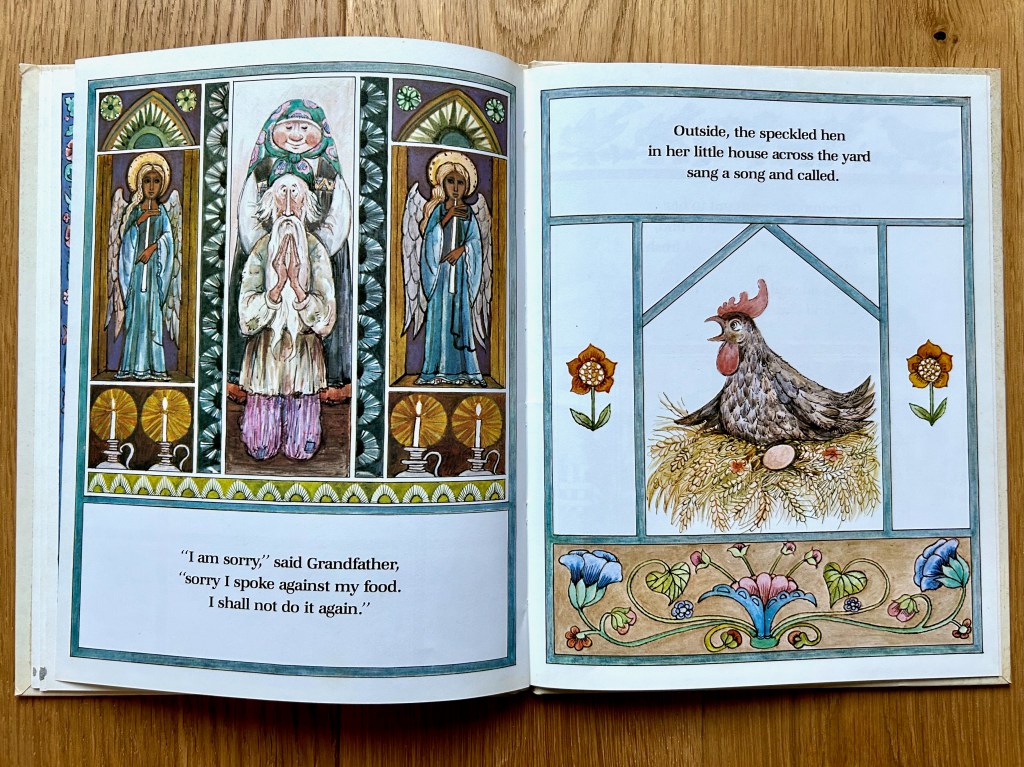
Another triptych on the left page. Three panels. The center panel is the grandfather on his knees praying while the grandmother stands smiling directly behind him. Two angels flank them in the side panels holding long white horns and four lit candles glow beneath them. Grandfather’s needed apology sits in the bottom box, apologizing for speaking against his food.
On the right page, the speckled hen is sitting in a lovely nest with a simple brown egg. She looks happy again. She is looking towards the praying pair on the left with beak open apparently singing a song and calling to them. Flowers bloom in borders around her.
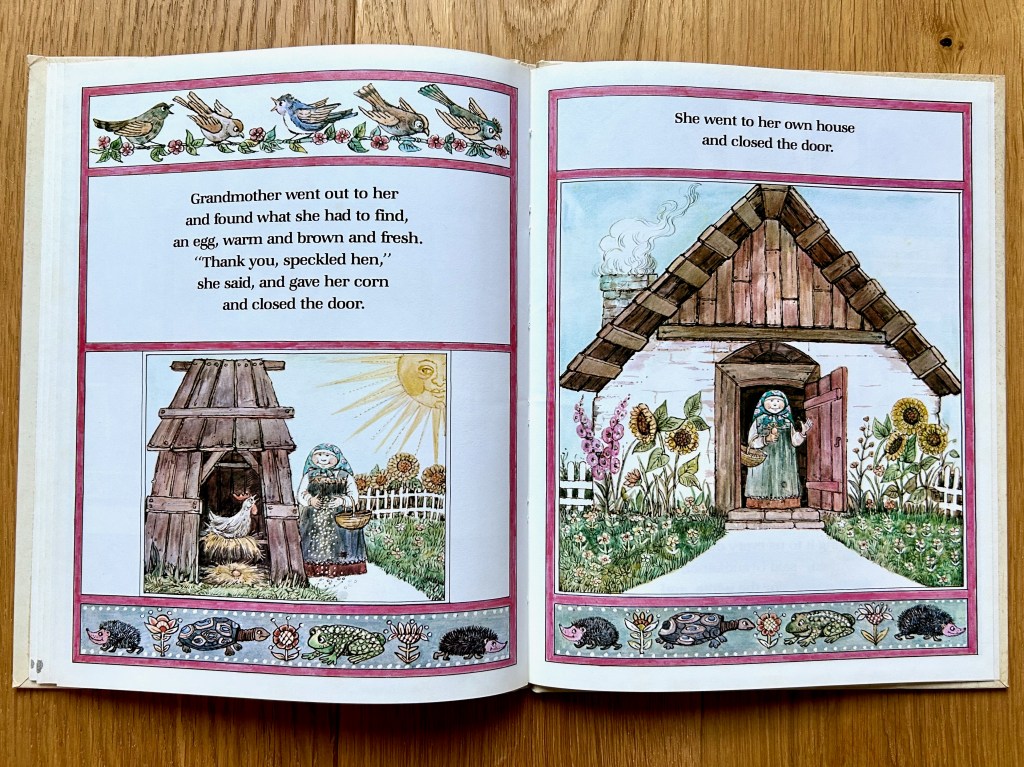
This time Grandmother goes to the hen house to find what she had to find. It was “an egg, warm and brown and fresh.” She thanks the speckled hen and gives her corn and closes the door. The sun looks on.
Birds decorate the top border. And the hedgehogs are back with a turtle and a frog in the bottom frames.
On the right, the grandmother stands in the doorway of her own house. It is a lovely looking house with sunflowers bold and blooming on each side of the door and smoke drifting from the chimney.
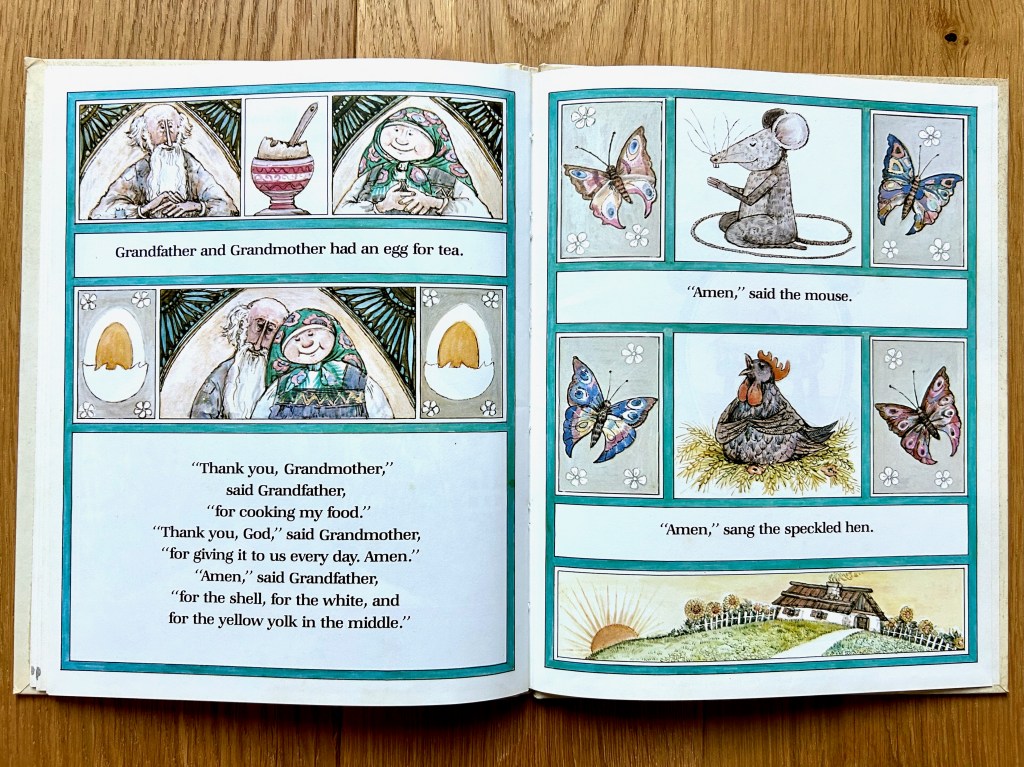
“Grandfather and Grandmother had an egg for tea.”
(If this seems odd to my American readers, tea, in this case, is a light meal. Dinner is the heavy meal of the day whenever you have it. If you have dinner at noon, you have tea for the evening meal. You can also have tea to drink anytime. It’s confusing, but makes sense in the UK.)
The top of the left page is another smaller triptych. Half an egg sits in an egg cup in the center with a spoon coming out of it. Grandfather and Grandmother sit in the side boxes looking admiringly at the egg.
Underneath that is three more boxes. The center has Grandfather and Grandmother leaning into each other with soft smiles and eyes closed. Content. An interesting open egg, but fully intact hardboiled egg sits on either side of them.
The text holds their thanks. Grandfather says thank you to Grandmother for cooking his food. Grandmother says thank you to God for giving it to them every day. Grandfather echoes her Amen and adds “for the shell, for the white, and for the yellow in the middle.” He has learned.
On the right page, three segments of boxes stripe the page. The top, the mouse is kneeling, facing the left page, with eyes closed and hands in prayer. His tail circles him on the floor. Two butterflies float in boxes on either side. The mouse says “Amen.”
In the center line, the hen sits on her nest with wings in a prayer-like pose. Her head is upturned and her mouth is open singing “Amen.” Two butterflies float on either side of her.
The bottom stripe is one long, thin box. The house sits cheerily on its hill again, with the sun setting behind the hill. All is right again.
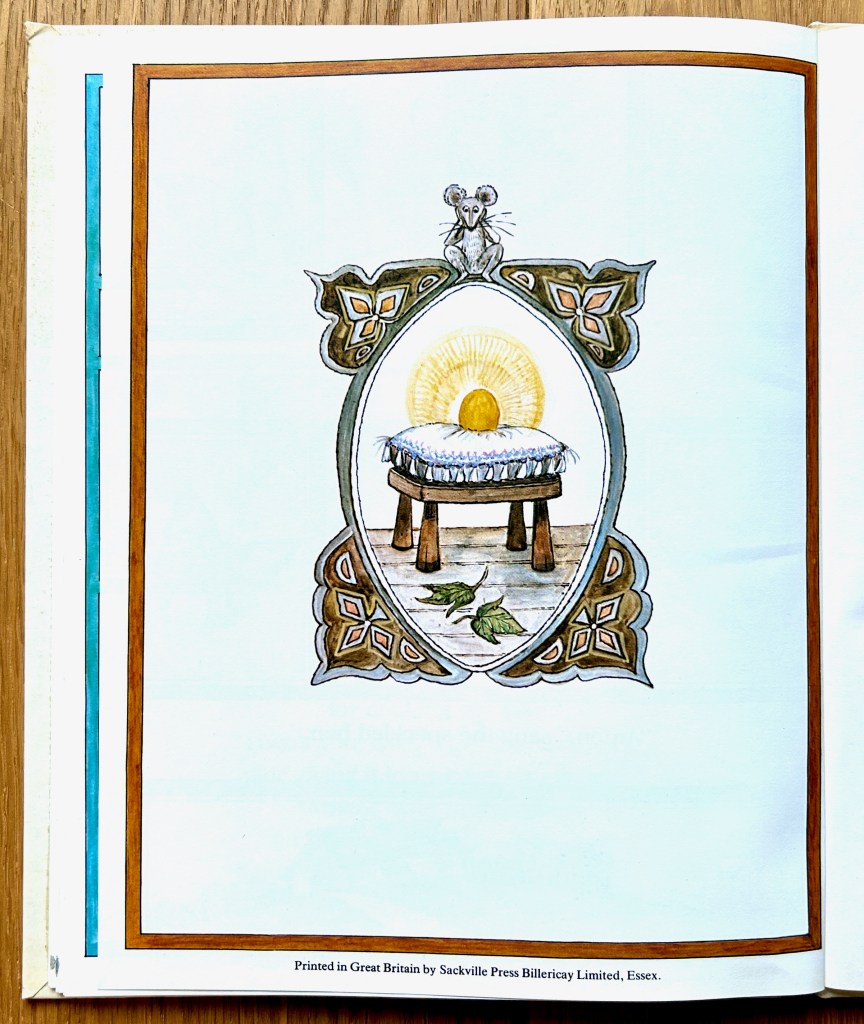
And the last page is the golden egg sitting on the cushion on the stool with two leaves on the floor. This vignette is framed decoratively in an egg-like oval and the mouse sits on the top center of it with his elbows resting on his knees and his face in his paws looking down at the egg. What an ending.
Well, if you made it through this review, congratulations and thanks for joining me in this intensely deep analysis of a crazy 1980s picture book. This is truly why I began this blog ages ago. Because no one ever wants to discuss picture books with me in the depth and obsessively passionate way I like. So thanks for reading if you did. I hope you enjoyed it and learned something along with me. I sure did. And I look forward to going back to my own work now, creatively refreshed and inspired. Until next time and our next book!
Final note/disclaimer: Upon finishing writing this review, I was doing my usual spell-checking and adding links where needed when I came across startling information about the book’s author, William Mayne. I was completely unaware of his conviction. I am disheartened and saddened by the information. I mulled over what this means for his books. I can’t say how I would have approached this book’s discovery were I familiar with him previously. But as I chew on the information, I read some articles about him and had a good think. Overall, I think lots of beloved children’s authors have sordid histories and I’m not sure anyone has decided how to handle them. Can we distinguish between the person and the imaginative work? Is the person defined by their worst decisions? Are we all? I think it is a case-by-case basis and left to conscience. So, I still admire this book and will continue to read it, but I leave it to you reader to make your own decision about Mayne’s works. In this case especially, I don’t think the text is the clear star anyway. The illustrations take the cake without a doubt! So, what’s the history behind this book. Was it solely Mayne’s genius or likely we should look to and celebrate Krystyna Turska more? Ah, the ever-present argument and question behind collaborative picture books. A discussion for another post and another time perhaps, and best offline. Here are some of the articles I found helpful to learn more about Mayne’s incredible portfolio of work and accolades as well as others who wrestled with this issue when it happened 20 years ago: Mayne’s obituary in the Guardian. An article in The Independent. A Guardian opinion piece.
If you are wrestling with the author, or even if you aren’t, I highly recommend focusing much more on the illustrator, Krystyna Turska. She carried this book to incredible places and made it what it is. And her life and work is 100% worth investigating and admiring.
With the best intentions for honesty and transparency, thanks for reading. – Caryn



 Three Books a Night