Skip to content

Three Books a Night

passionately sharing, discussing and admiring children's picture books

  • Home
  • About
  • Review Policy
  • Contact

Tag: 1980s

The Man Who Loved Books 1981 book

Review: The Man Who Loved Books By Fritz & Schart Hyman

I have been on the lookout for this book for many years. I don’t remember when I first heard of it and I didn’t even know what it was about; but I adore Trina Schart Hyman’s illustrations and am always noting whenever I hear of another book with her work. Also, it is about a man who loved books. It’s got my attention!

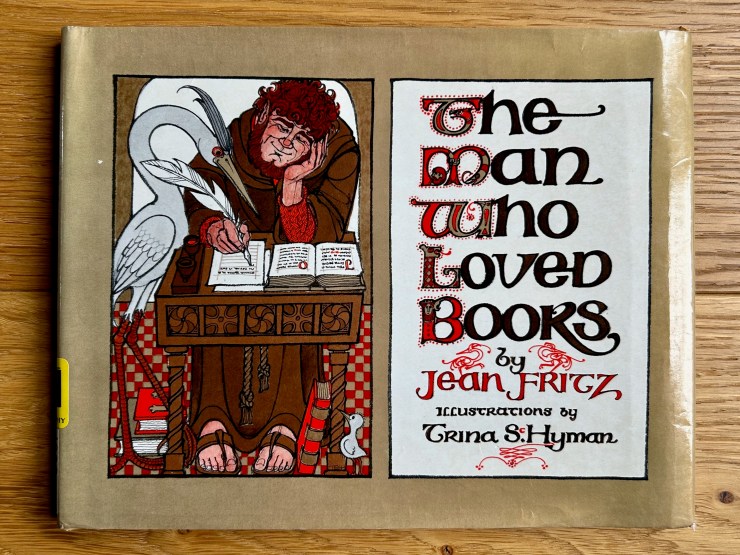
This is the story of Saint Columba – from birth to death – and his deep, obsessive love of books. Check out The Man Who Loved Books by Jean Fritz, illustrated by Trina Schart Hyman, 1981. As it is often difficult to find, I’m going to share it all. Enjoy!

First up, we have to peek at the undercover. You know I love a good undercover and this one is simple and beautiful. A lovely golden mustard debossed with Columba’s pet crane reading a book.
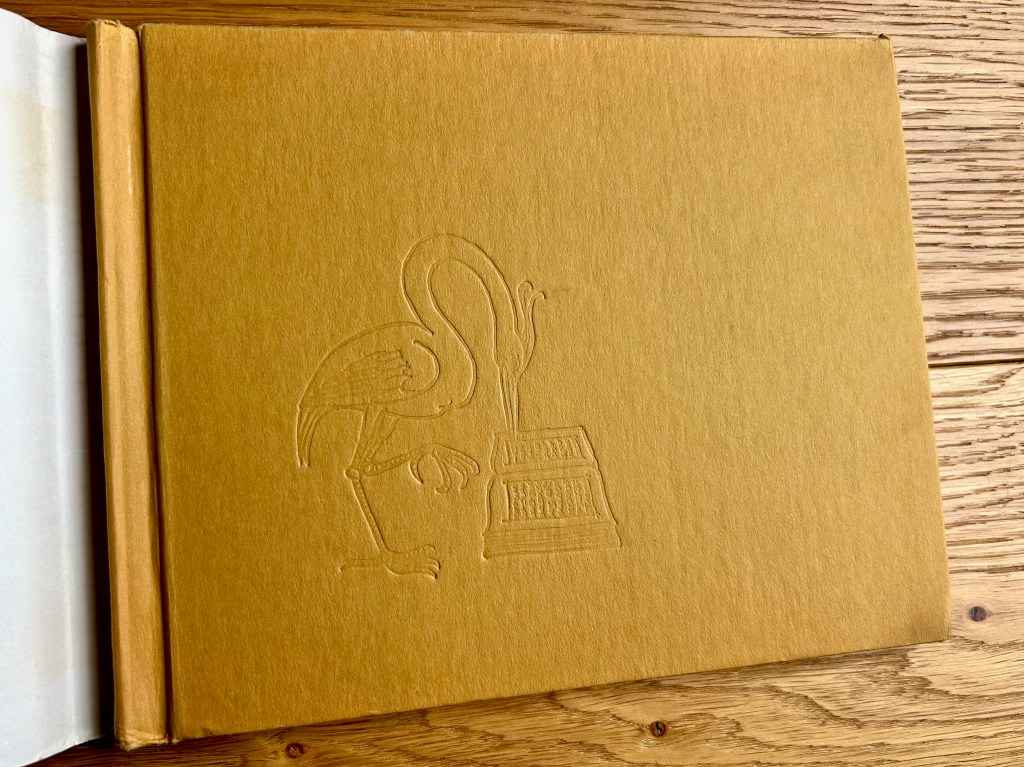
The undercover definitely sets the tone for the color palette in this book which is a two-color beauty. It is such a fascinating choice and feels like a unique way to handle an ancient time period and the life of a monk. It is also an odd choice when it comes to the beauty of Columba’s homeland, Ireland, and the island he eventually called home, Iona; but I get ahead of myself.
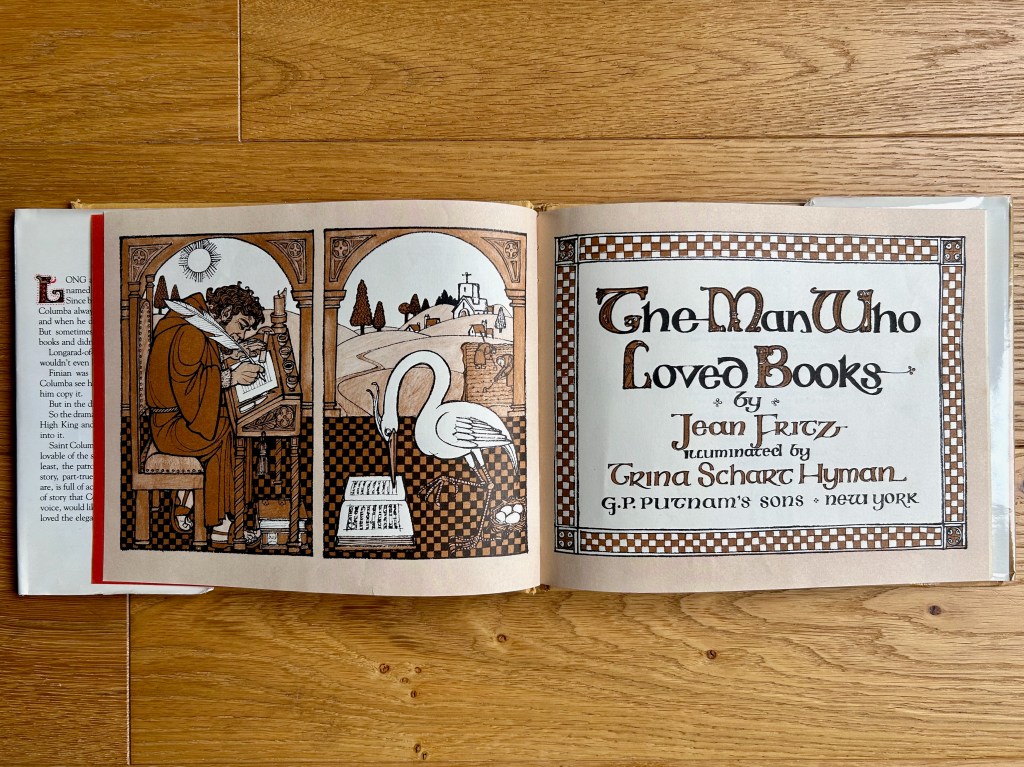
The title page and accompanying illustration are also things of beauty. Schart Hyman often did her own lettering and these are a great example of the style, artistry and decorations she would use. They have a medieval feel and also fit so perfectly with a book about a monk who hand-wrote books. Opposite the title page, we see Columba working at a manuscript and his pet crane reading a book. Just take some time to really take in all the details of this scene. The church in the background. Monks working the fields. Archways, tile floor, detailed writing desk, books stacked… I just love the detail and imagination Schart Hyman draws into every scene.

Quick side note to point out the dedication page. Schart Hyman dedicated her work to her friend, Tomie. Most likely famous illustrator Tomie dePaola. This made me smile. Illustrators supporting other illustrators.
On to the story.
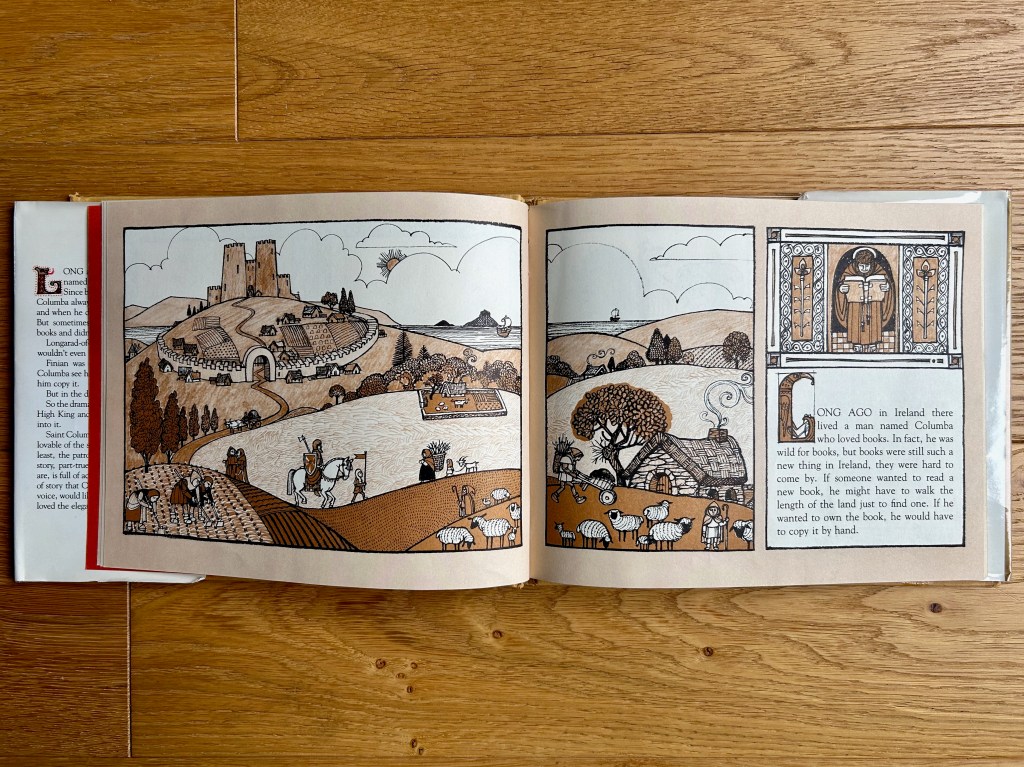
The book opens with a view of Ireland around the 520s and tells us of a man named Columba who was wild about books. At this point in time, books were hard to come by. You had to walk miles to find one and you had to copy one by hand if you wanted to own one. This is a super interesting opening to Columba’s story.
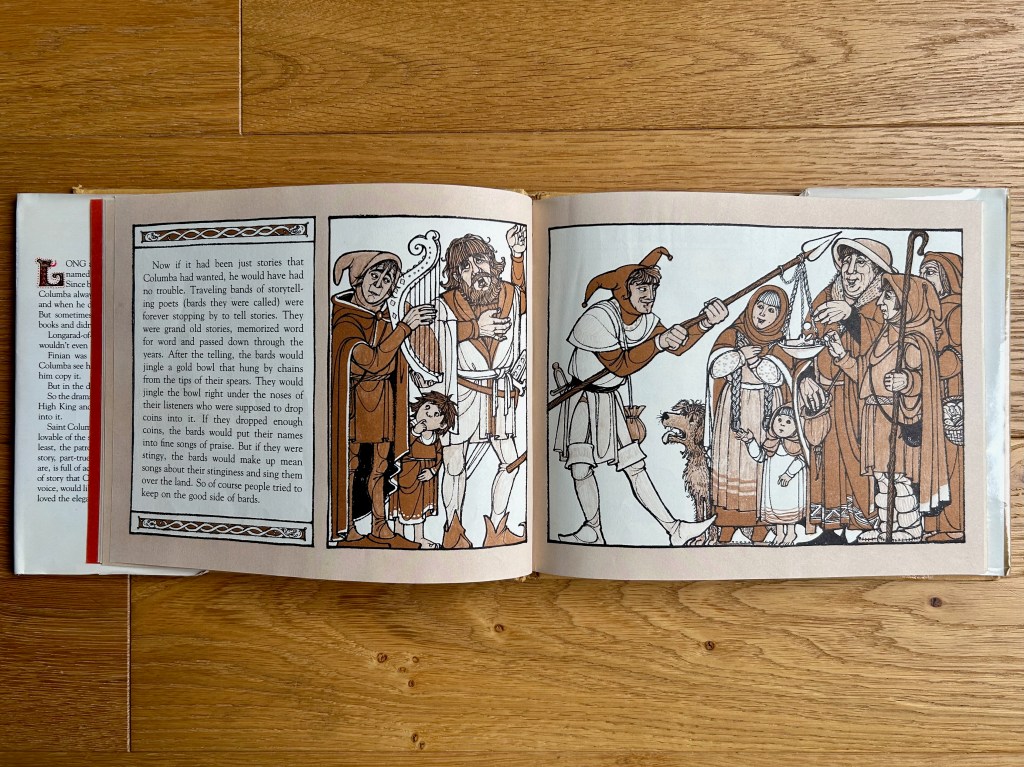
It also tells about the bards of Ireland and how stories were told and shared.
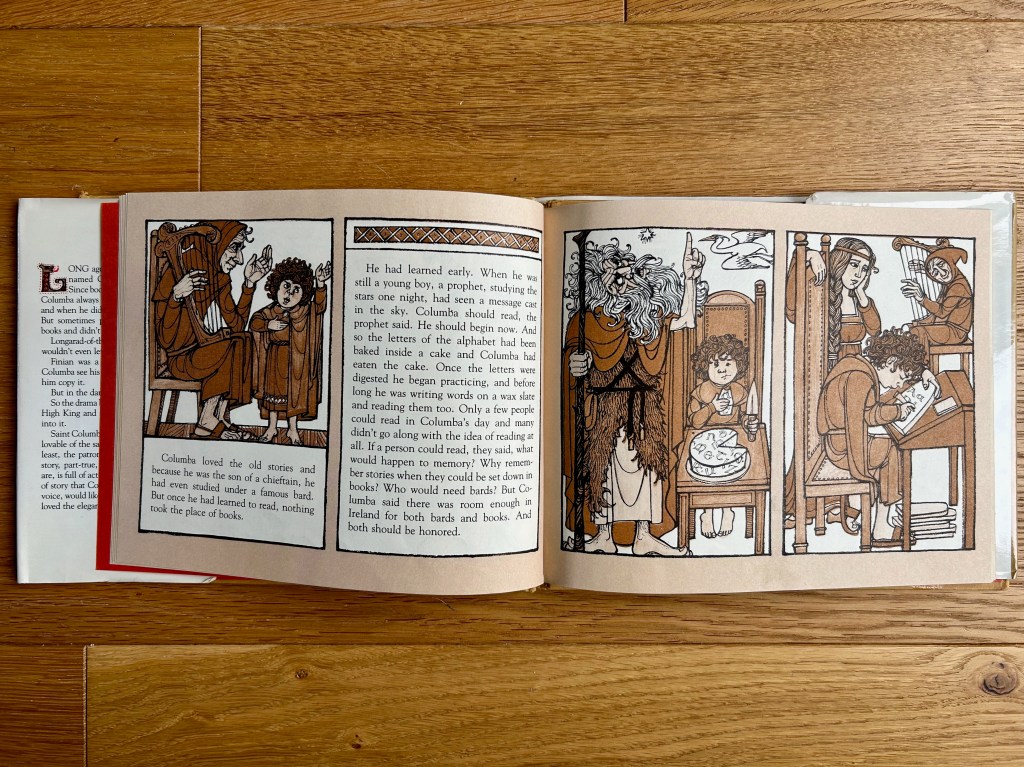
And then we see Columba, son of a chieftain, who grows to loves stories and especially books. He is taught to read early—myth has it that a prophet was told he must be taught to read.
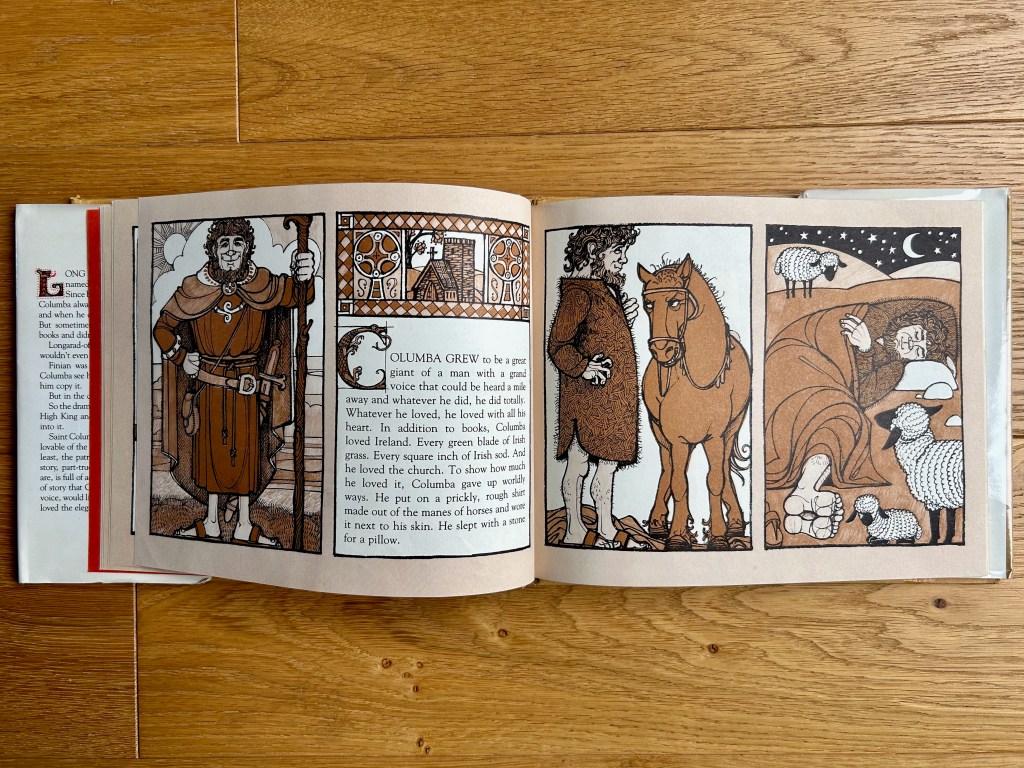
So Columba grows into a big man with a big voice and a big love for books. According to this story, Columba’s love for books became a problem.
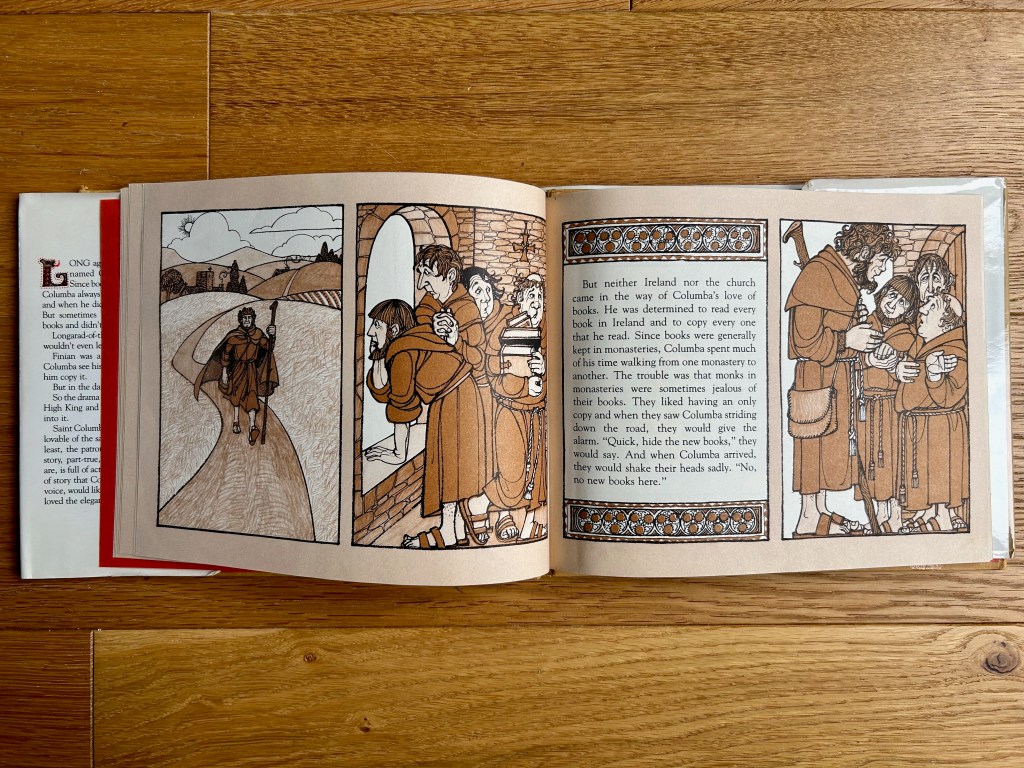
Columba butted heads with other monks over their fierce love and protectiveness of their books. Columba liked to not only read any book he could, but he also liked to copy them and have them for himself. This didn’t always go over great. And this was all before copyright and plagiarism laws.
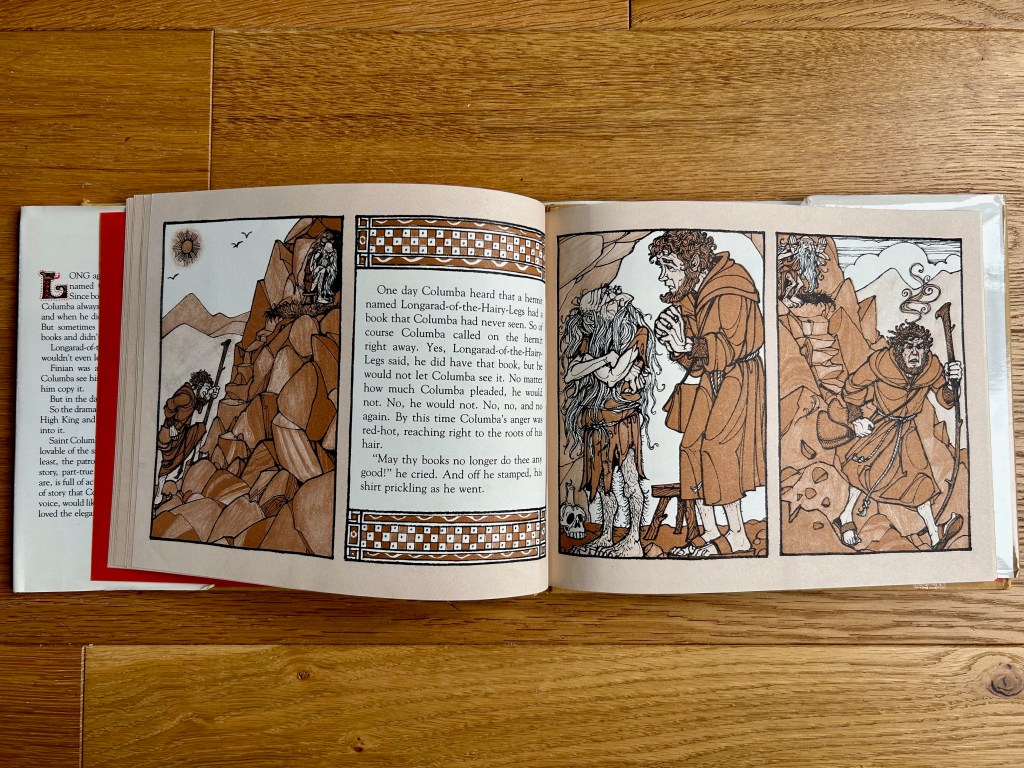
And Columba had a temper apparently too. His passion for books was growing quite the drive in him and it eventually all came to a head in another friendship.
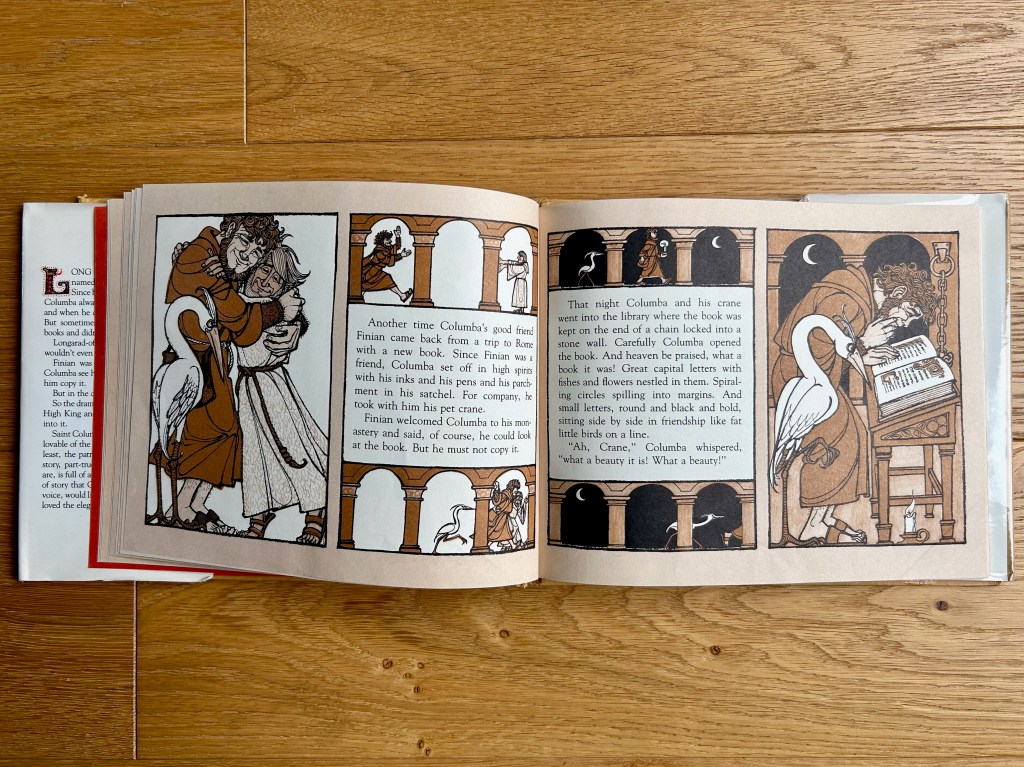
Columba’s friend Finian returned from a trip with a new book. Columba happily went for a visit with his inks and pens. And his pet crane apparently too. Finian was overjoyed to show Columba the book, but he told Columba not to copy it.
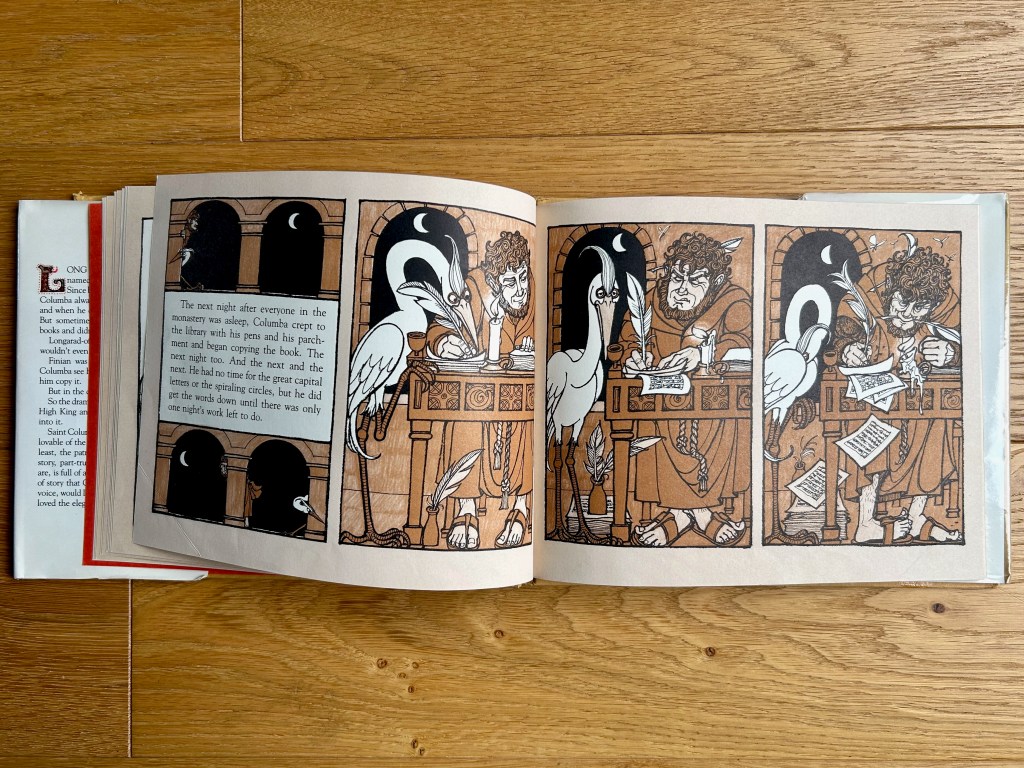
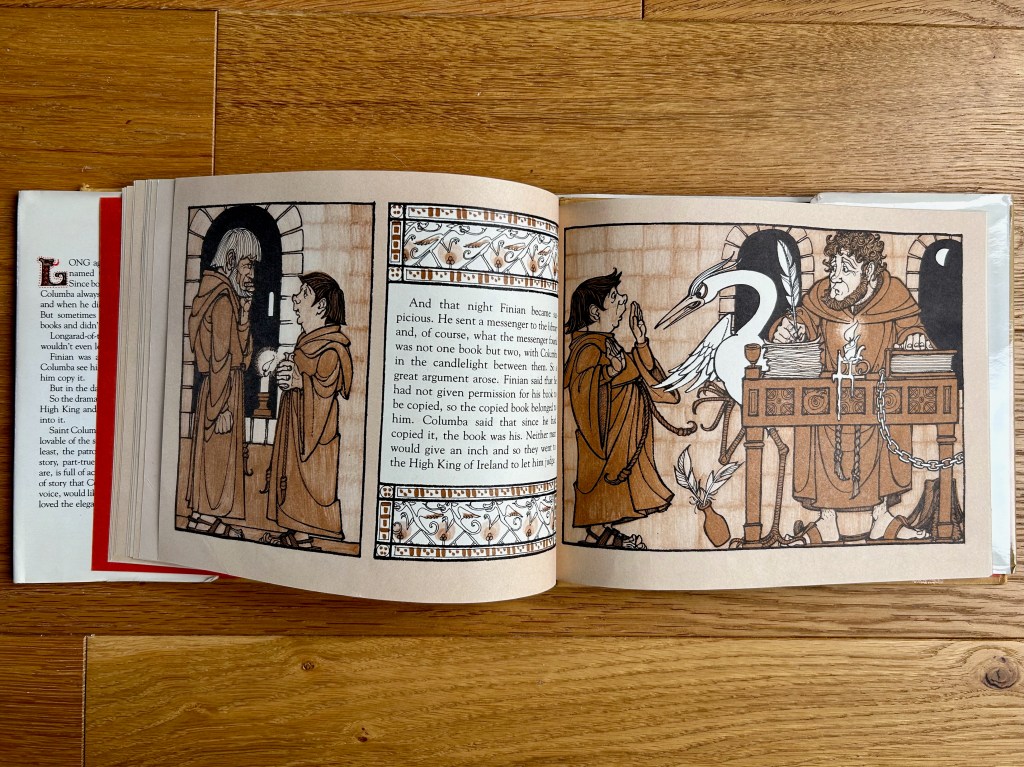
Columba didn’t listen. He secretly copied the book over many nights. A messenger found them one night and it all blew up. Finian claimed that he should get to keep the copy too. Columba wouldn’t hear of it after all the sleepless nights and labor he put in to copy it. The debate went to the High King and Columba lost. Finian got to keep the copy and Columba was irate.
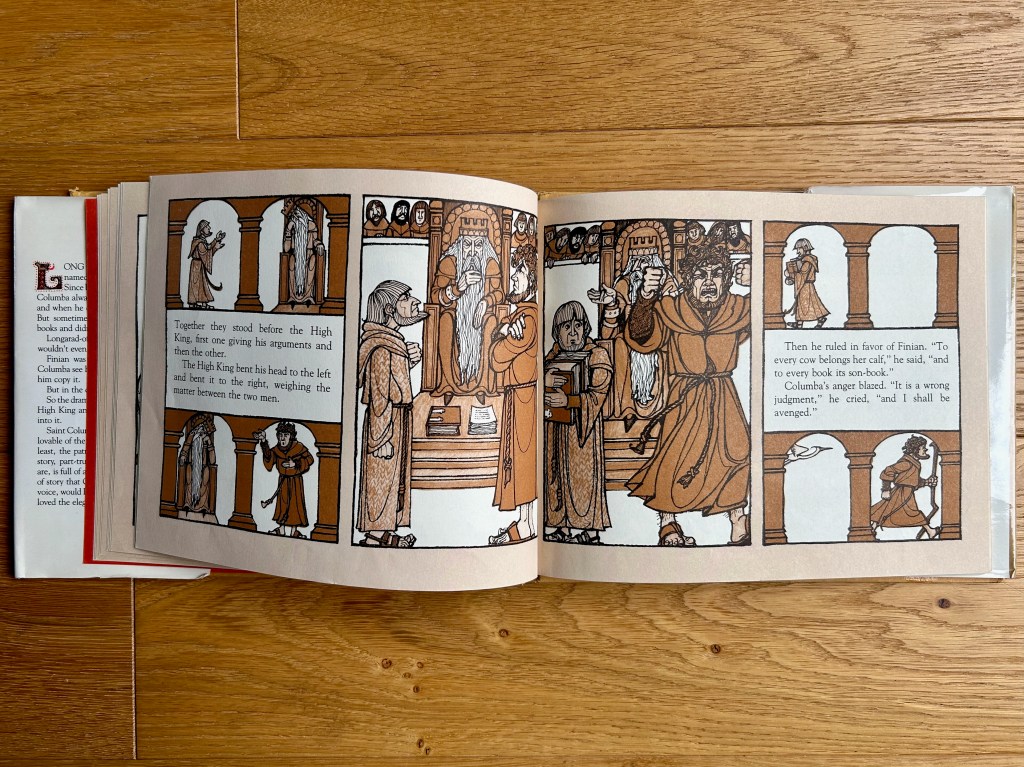
Unfortunately, being son of a chieftain, Columba had access to warriors and he declared war on the High King to avenge himself. He won that time. And many thousands of men died.
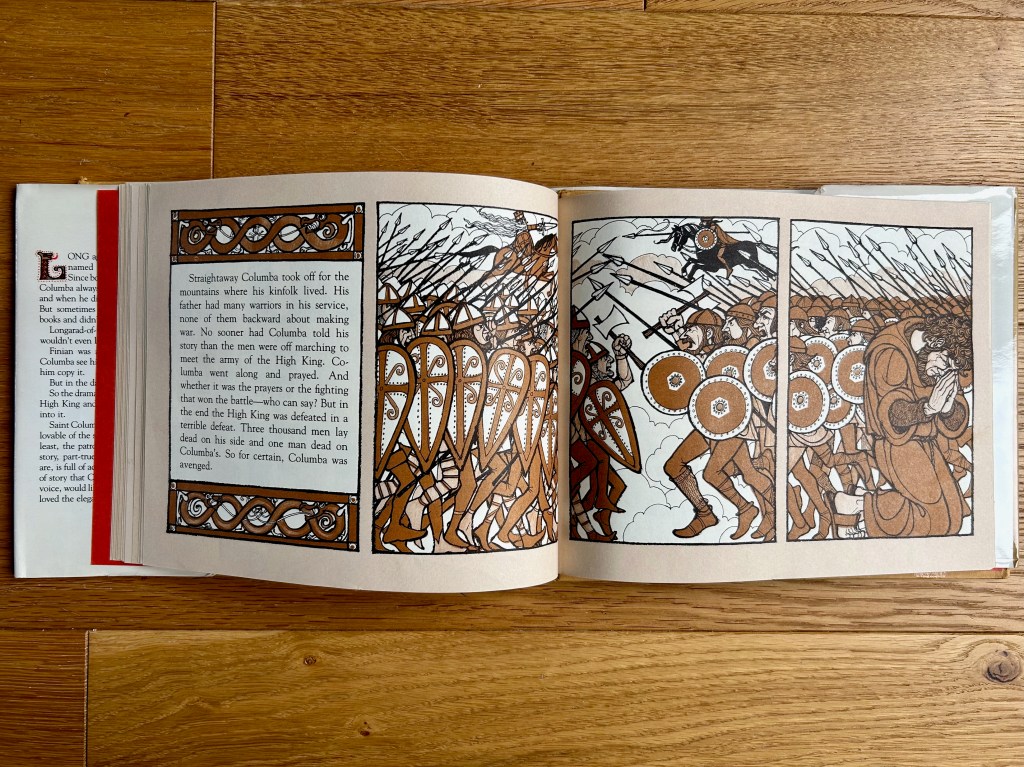
But Columba didn’t really win. He felt miserable. And this huge mistake changed the trajectory of his life.
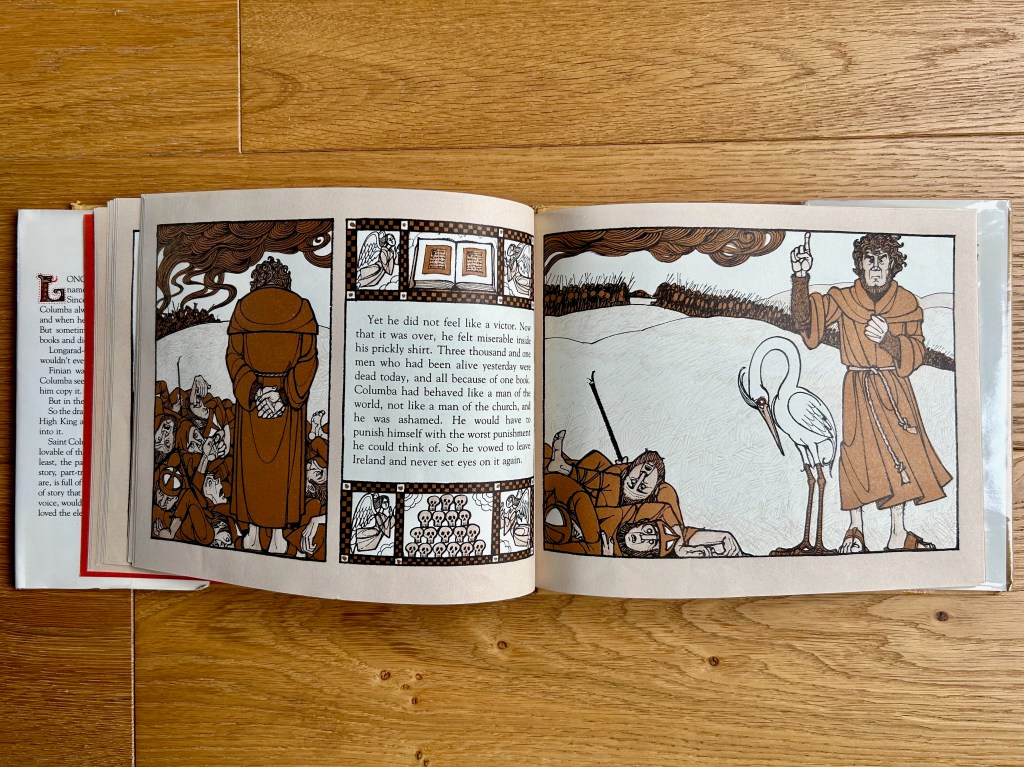
The book says he vowed to never set eyes on Ireland again. He set out with 12 companions to find an island where he couldn’t see Ireland any more.
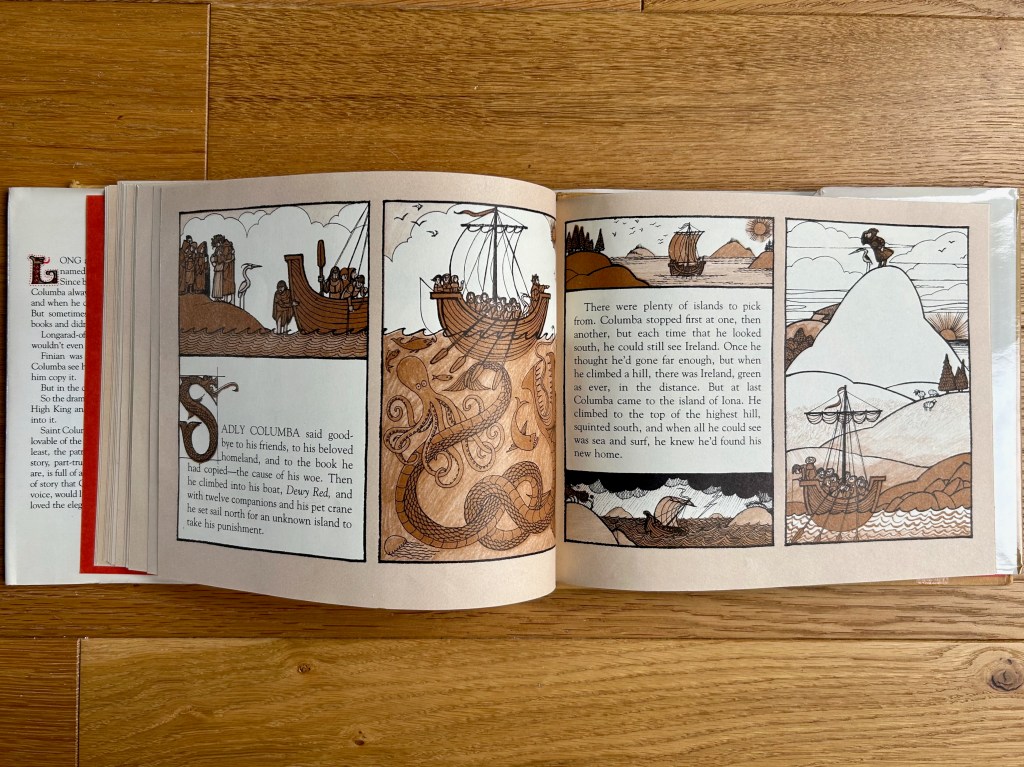
They settled on the island of Iona where they built a church and huts surrounding it. Columba traveled to nearby islands and parts of Scotland preaching and starting churches.
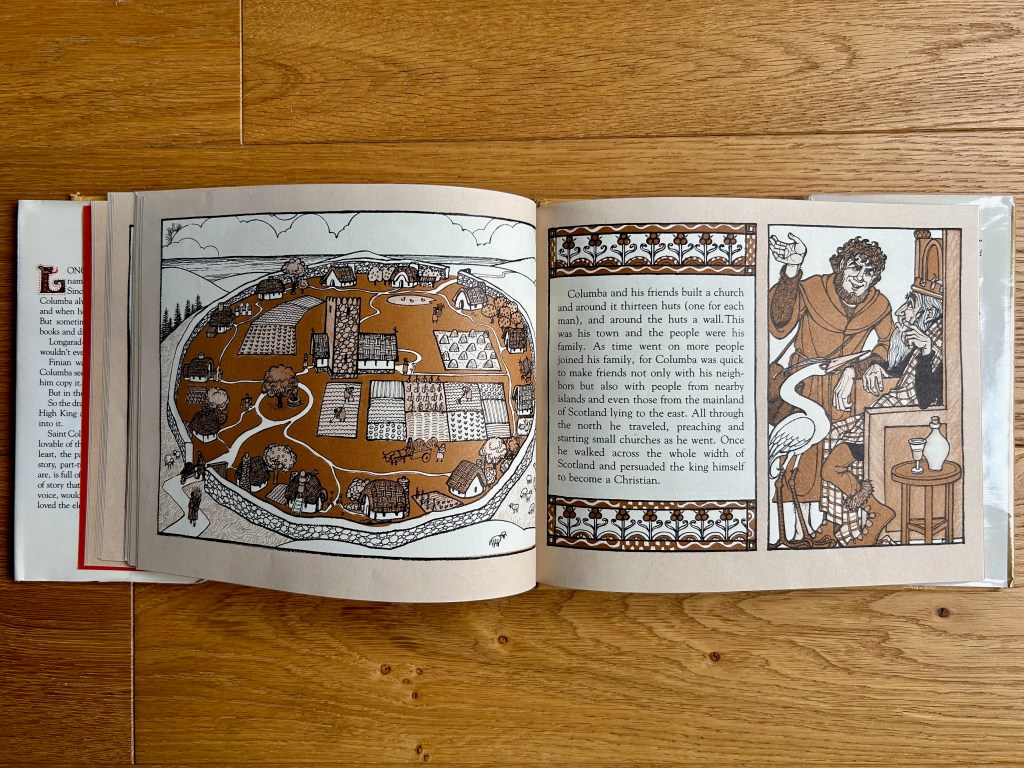
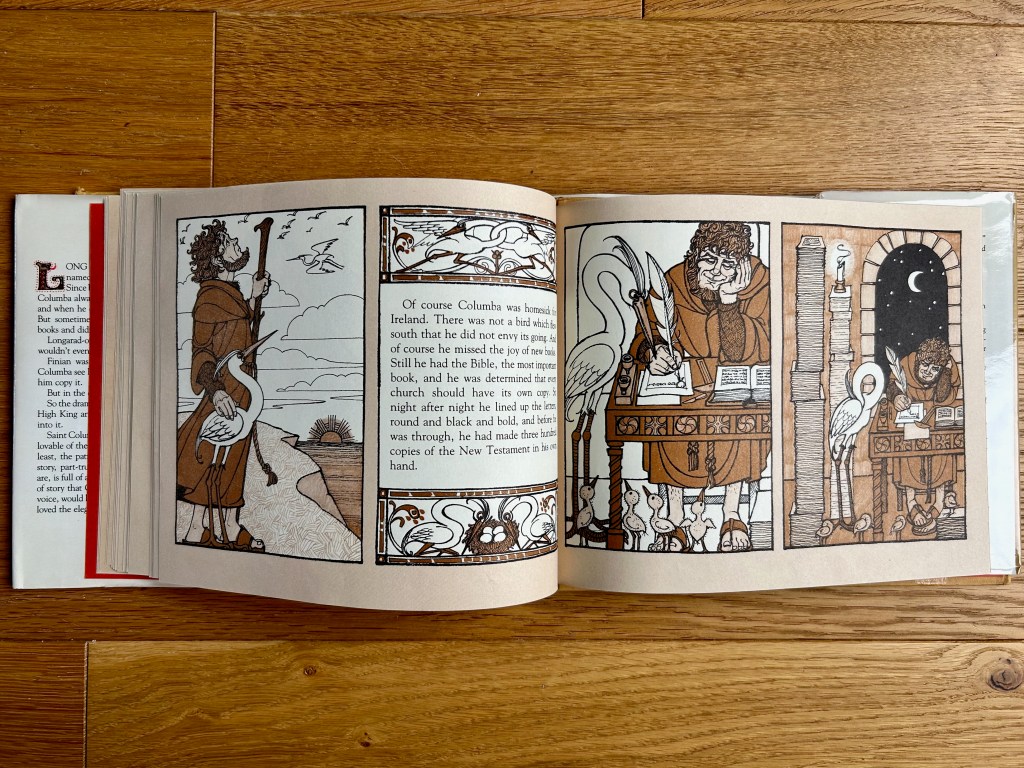
Columba was homesick and missed the joy of new books, but he took to copying the Bible, again and again. He wanted every church to have their own copy of the Bible. The book says he made three hundred copies of the New Testament by his own hand.
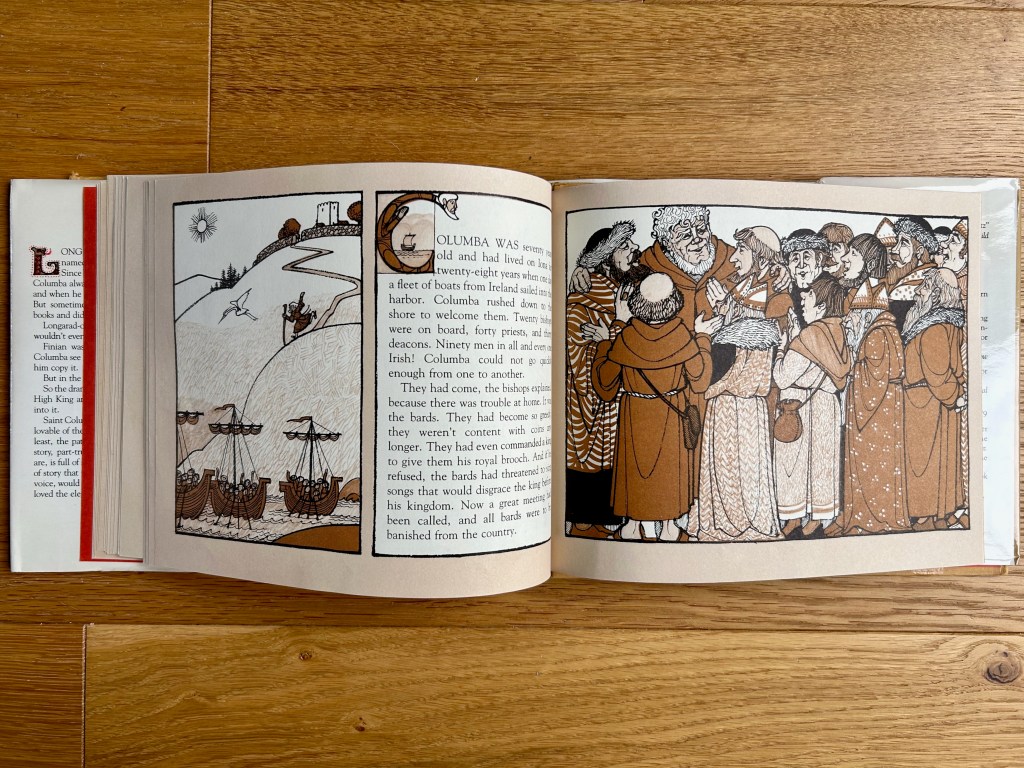
Twenty-eight years later, a boat came from Ireland with lots of his countrymen. They sought him about trouble back in Ireland between the kings and the bards.
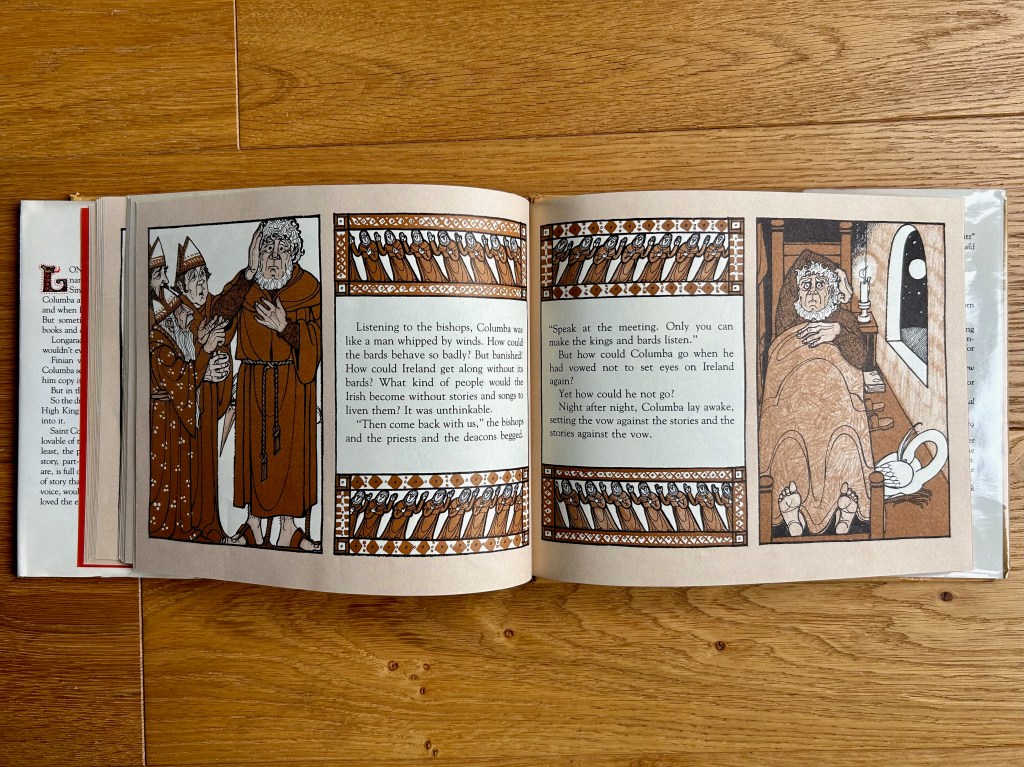
They begged him to come and help resolve the issue. But Columba could not break his vow. He agonized over what to do.
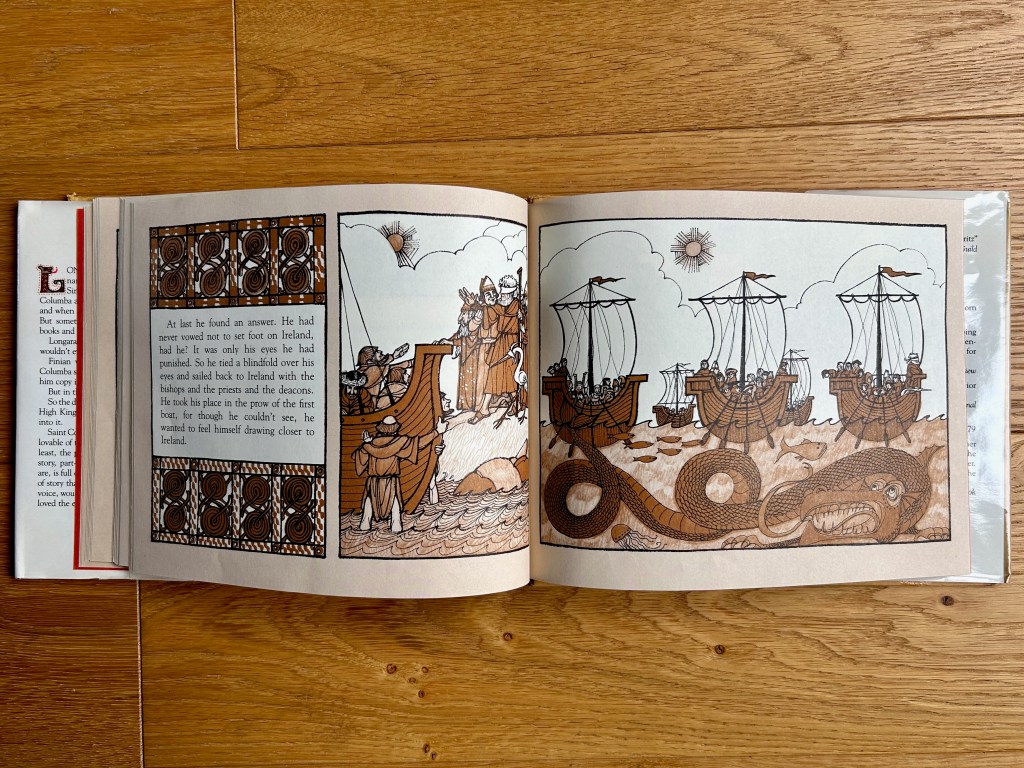
He finally found an answer—he traveled blindfolded back to Ireland. He brokered peace and returned to Iona, all while still blindfolded.
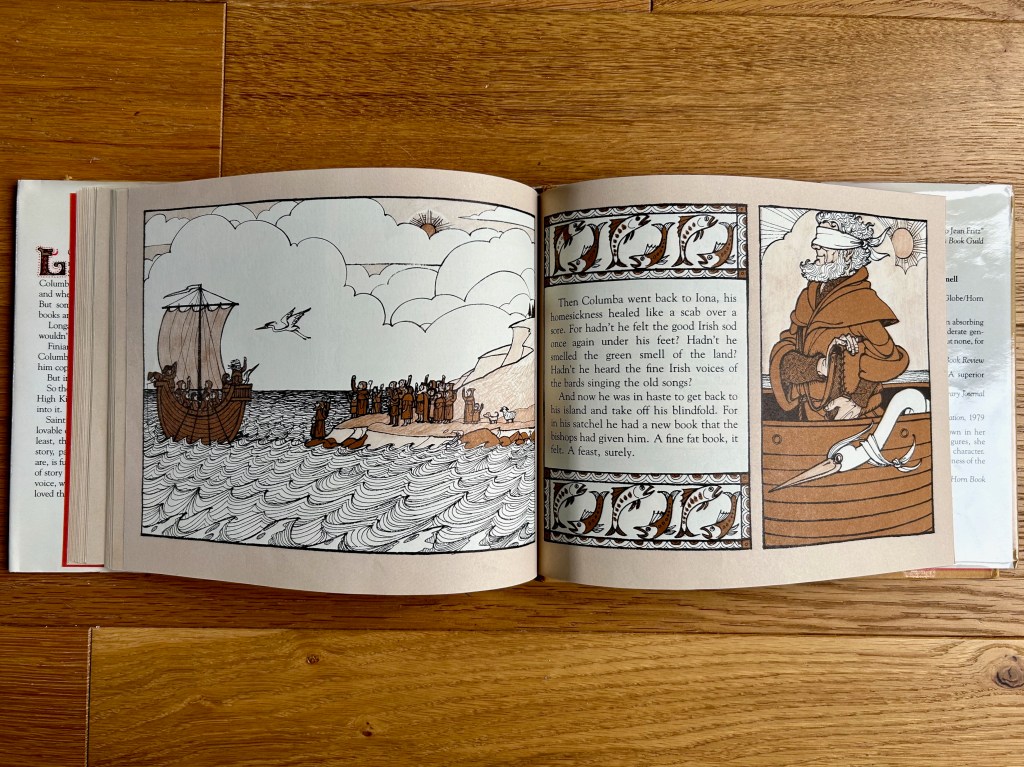
Columba worked and lived on Iona for 6 more years copying books. And apparently he died while in the middle of copying a sentence.
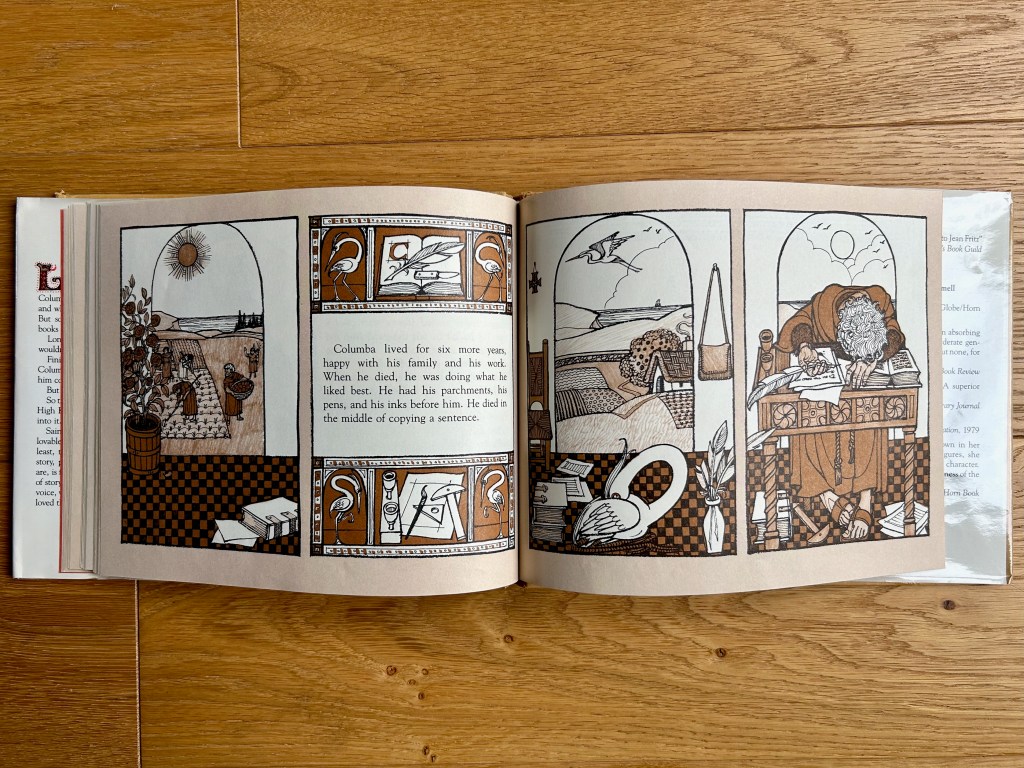
Oh, so much to say about this book. I could pore over every detail of the illustrations. I marvel at how I don’t find them boring with their limited, earthy palette. But no, a Schart Hyman illustration is never boring. I love following the crane throughout the book. I love all the expressions of the people. I love all the patterns and items placed so thoughtfully and adding to the story. And the ship scenes too! I even love the details of hair that Schart Hyman does so well including the addition of red in just the cover which is so great. Such a talent.

But something super interesting about this book is that it is missing something incredibly important about Columba. The author, Jean Fritz, was a great children’s book writer, known for lots of excellent non-fiction stories and biographies. And she does just fine here with a good story about a man who loved books. And it is an interesting piece about Columba’s life that I especially connect to. And actually there are quite a few, even wilder myths about Columba that would have made an even more fascinating tale. I respect that she stuck to stories about him that are the most probable. But Fritz missed the biggest piece about what changed Columba and what ultimately drove his decisions and life on Iona. The text mentions Columba loving the church and the Bible, but not once does it mention how much Columba loved God. And to miss that point, means you miss Columba’s story completely. Columba is one of my favorite saints for a lot of reasons, but I think this article by John Gee from 2021 puts it in some of the best words.

“Typically, when we discuss saints in the liturgical setting, we are speaking about people that are close to perfect. These are people who have surrendered their entire life to Christ. In many cases these amazing people have done amazing things. They have helped countless numbers of people. After all, they are saints of the church, they could do no wrong. But because they are considered so close to perfect, they sometimes seem inaccessible or even too good to be true.

This is simply not the case with Columba. What we find in Columba is a person who has grievously hurt others and will spend a lifetime trying to right a wrong. Saint Columba is so attractive to me because Columba was human. His whole story is told, mistakes and all. I believe today we do not need a perfect example of piety; we need an example of humanity. An example of a person who commits error, owns it, and spends the rest of their life correcting it. This is a story the world needs. This is the story of Saint Columba of Iona.” (read the whole post for a great look at Columba)

As Emily Watkins puts it in another good post, “Columba loved God’s story.” And it changed him completely. He didn’t just banish himself from Ireland. He set up a church on Iona and used it as a base to spread God’s story all over islands and most of Scotland. He hoped to change as many lives as he cost with his self-righteous anger. It is said of Columba that as he aged, he grew gentler. The temper that had driven him in his younger years, was replaced with humility and care for others. And yes, Columba loved books. But the rest of his life shows as Emily Watkins continues in her post, “He did not simply desire to possess a book, but longed to love others by telling them the story that would change everything.” Like it changed him.

So, I really enjoyed this book about Columba, a man who loved books. I will always adore and admire Trina Schart Hyman’s brilliant illustrations. But this book drove me to think about what was missing from his story. To quote a great American, it matters who tells your story. I’m sorry Fritz and Schart Hyman might have missed it in all their research of him. And, don’t get me wrong. If you know me at all, you know I don’t like overally didactic books. I didn’t want or expect this book to be preachy. But I do think the key point of Columba’s life work is a key point of his story and leaving it out – no matter what you personally believe – isn’t being honest to who he was.

I don’t think Columba would mind being known for loving books. Or having a pet crane, which is a funny detail that deserves its own story. Or that people remember his temper and how it once killed a lot of people. He would not have wanted to be painted as a spotless saint who did a lot for the Church. I like to think Columba would want to be known for loving books, but most especially for loving and spreading the greatest story ever. He spent years of his life writing and sharing that story. And it is even said he died while copying from the Psalms. A true lover of the best books.

“Alone with none but thee, my God, I journey on my way” – Columba of Iona

April 17, 2026April 17, 2026

CarynLeave a comment
Cover in white with old man and old woman sitting at a table looking at en egg in an egg cup between them. A mouse sits on the floor looking up at them.

Review: The Mouse And The Egg By Mayne & Turska

Today I bring another recent vintage find. It is an odd book that I adore and it makes me chuckle and I’m not quite sure I completely understand it. So I keep reading it and delighting in it and isn’t that the point of books anyway? This is definitely an odd choice of book for Ash Wednesday, but there are not many books I would consider fitting for Ash Wednesday and this one actually feels a little fitting. Come have a look at The Mouse and the Egg by William Mayne, illustrations by Krystyna Turska, 1980.

(As it is vintage, I will share more of it than I do with new books since it is unlikely you will find a copy easily.)


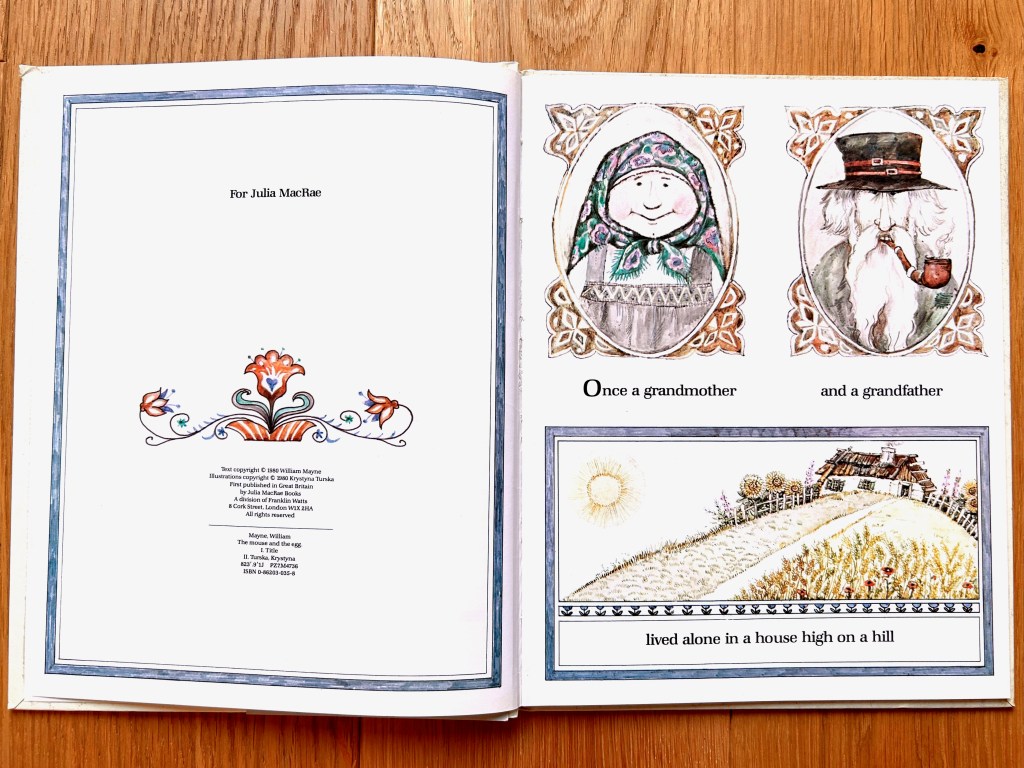
White page on the left with the colophon. Vignettes on the right with the grandmother and grandfather in their own boxes and their house on a hill in the bottom box.

The story opens with a glimpse of a grandmother wearing a scarf on her head and a grandfather with a hat and a large pipe. We are told they live “alone in a house high on a hill.” The house looks modest, but charming seated high on that hill with sunflowers blooming around it and the sun shining brightly over it all.

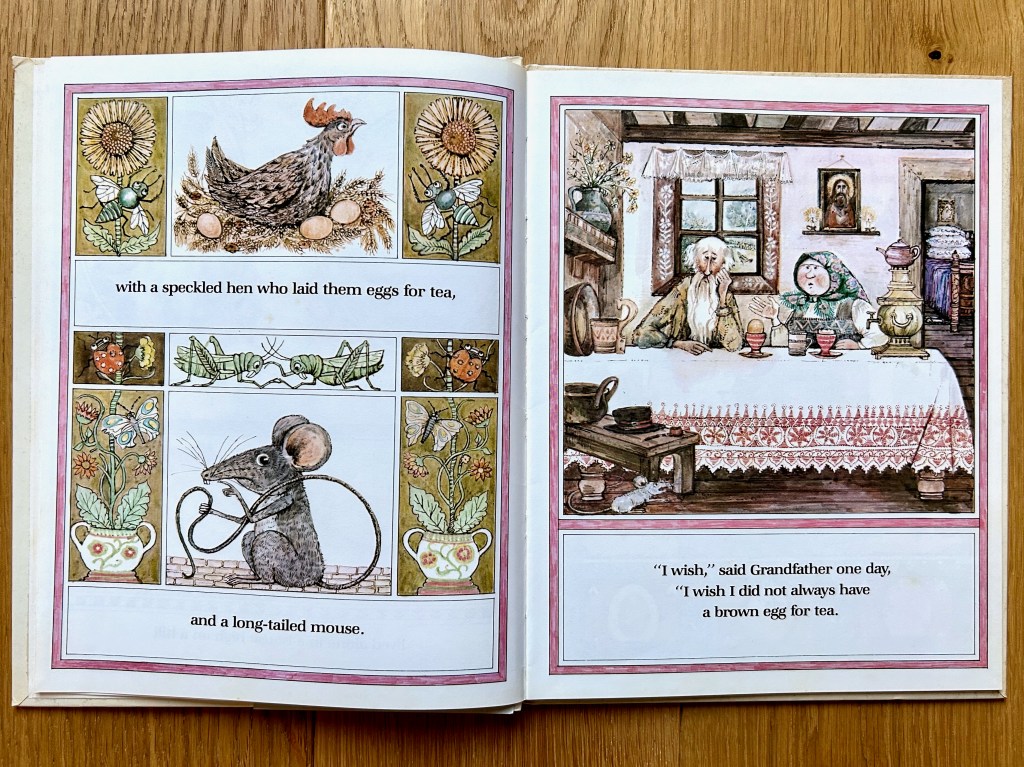
Though we are told they live alone, we are next told that they live with a speckled hen who laid them eggs for tea and a long-tailed mouse. It is a very long tail. He looks mischievous. And there is definitely something up with the mouse. But we should know that since he is in the title of the book.

I’m going to stop here to go ahead and already talk about the illustrations. They are the star of this book without a doubt. The style is stunning and caught me from the very first page of the book. It has a vintage vibe, and a muted palette which I think is intentional; but also feels very indicative of painting in watercolors that are never quite as saturated as acrylics or gouache. This page already speaks to the reason I grabbed this book: the decorative framing of the illustrations. Fascinating. You could be silly and skim over them as merely fun decorations, and perhaps they are, but you miss a lot of the delight in this book if you skip them. Just like a thoughtfully decorated house makes you feel cosy and shows a deeper story of the family who lives there; the decorations here seem to do the same. They don’t necessarily tell any part of the story, but they are lovely and stories in themselves and add depth to the pages and the story. They remind me a bit of Jan Brett books, but I’ve never adored her use of these decorative frames as much as I delight in these. (Sorry to Brett fans.)

On the right page, the story has moved past introduction of the key players and we have a bit of a record scratching moment. The grandfather declares one day that he wishes he did not always have a brown egg for tea. Cue ominous music or uncomfortable silence, whichever you imagine.

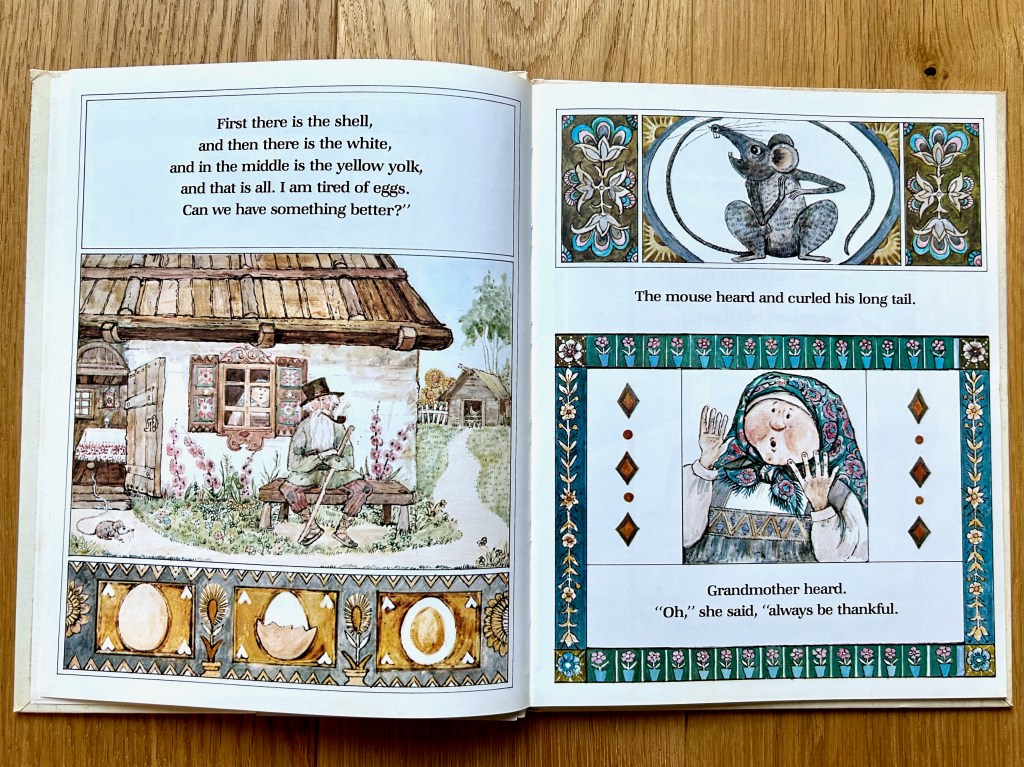
Left page is the grandfather sitting outside the house on a bench with his pipe and arms crossed. Right page is split between the mouse looking horrified and the grandmother looking shocked and responding.

He goes on to explain his complaint that there is the shell, the white and the middle yellow yolk. That is all. He is tired of eggs and wants something better. Underneath his clear pouting pose on a bench with his pipe, we have a panel showing the egg in its three apparently offending parts. I’ve never admired an illustration of an egg so much. I would frame that in my kitchen; it is so lovely.

Well, the mouse is horrified and curls his long tail over himself.

Grandmother is also aghast and exclaims that you should always be thankful.

(Sidenote: My girls frequently binge episodes of The Story Pirates podcast and it is a common occurrence that something happens and all the pirates gasp, but one of the pirates actually says the word “gasp.” Every time I hit this page, I hear that in my head.)

I think this moment is actually key in the book, as understated and early on in the story as it falls. There is not much explanation for what next occurs and we have to wait for the circle back moment even as it isn’t explained. Stay tuned.

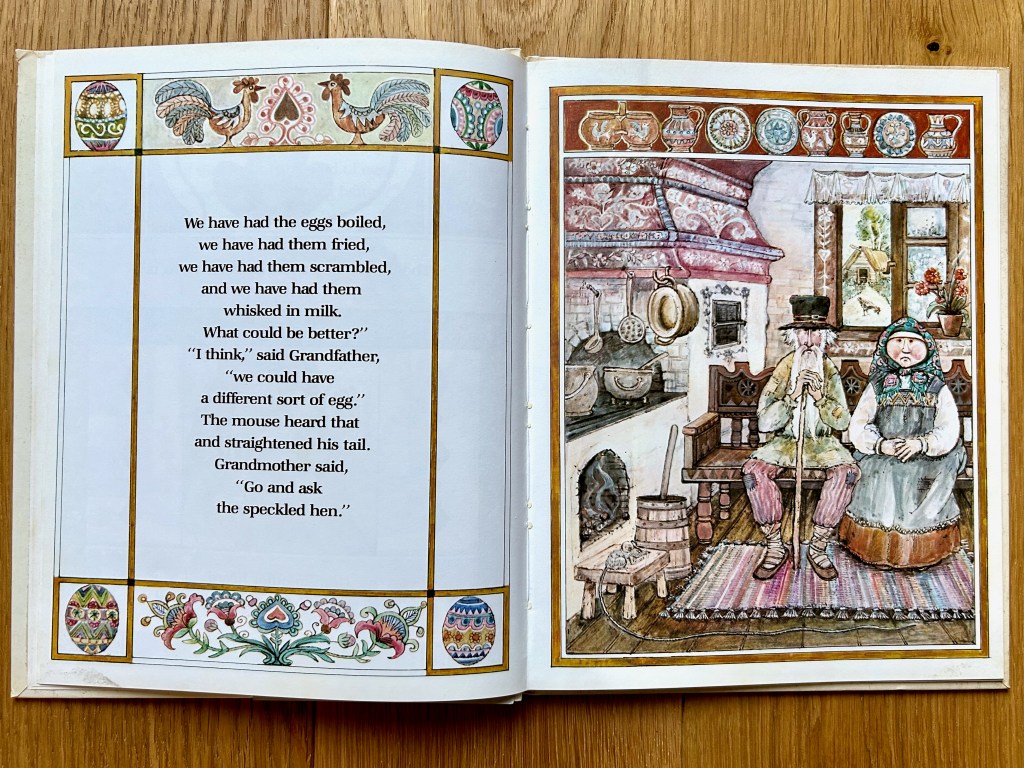
The grandmother then attempts to list all the ways that she, though she says “we,” has made the eggs for them to enjoy in the past. What could possibly be better? I want to read this moment in an exasperated tone, but she looks too sweet and seems more incredulous and worried at ungratefulness in general than not directed towards herself. I also love that this text is framed by gorgeously decorated eggs and fantastically plumed hens. Don’t skip the decorative frames!

The grandfather thinks they could have a different sort of egg. “The mouse heard that and straightened his tail.” It is an incredibly long (longer than it was previously?) tail. I have no explanation here. Just stick with me.

Behind the main image, you can just see the hen out in the garden unawares and pecking at the ground.

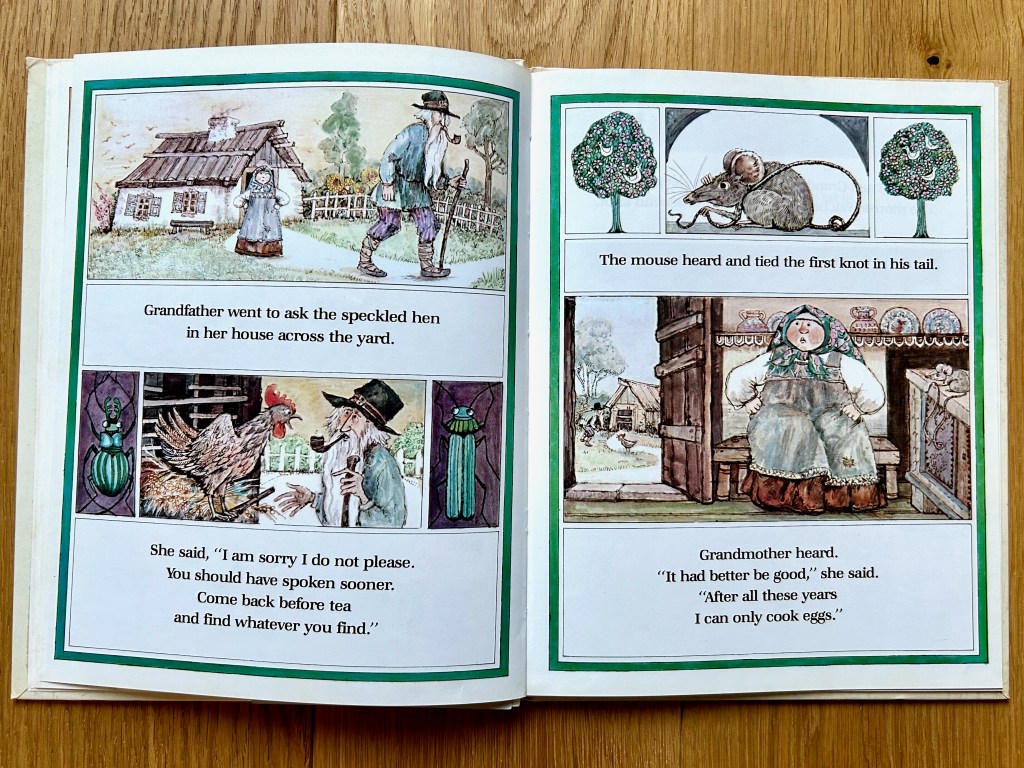
Left page has split images of the grandfather walking from the house while the grandmother looks on with hands on hips. Then he is talking to the hen looks a bit shocked. The right page has the mouse slinking and looking embarrassed and the grandmother watching it all from the house still with hands on hips.

The grandmother has told the grandfather to go ask the speckled hen. So he does. The grandmother looks on with hands on her hips. Body language is everything.

The hen responds shockingly politely with an apology. This is very British. There is a common stereotype/joke/fact that British people apologize often and often unnecessarily. Perhaps it is also passive aggressive (both from the hen and British people…) The hen apologizes that she does not please. Says he should have said something sooner. And she invites him to “come back before tea and find whatever you find.” I think we need to insert some ominous music here too. Dun dun duuuun!

From the right side of the spread, you see the mouse cowering or hiding, looking clearly embarrassed for the grandfather and them all apparently. And we are told he ties “the first knot” in his tail. What is happening? Is this the British equivalent of a “strike one” that we would say in America? I have so many questions.

The grandmother can also be seen on the right side, still with hands on hips; but she has moved behind the house door and is possibly hiding inside the house out of sight of the hen and this embarrassing situation. She heard the conversation and expresses concern that hopefully whatever he finds will be good because she doesn’t know how to cook anything but eggs after all these years. I can’t help but giggle.

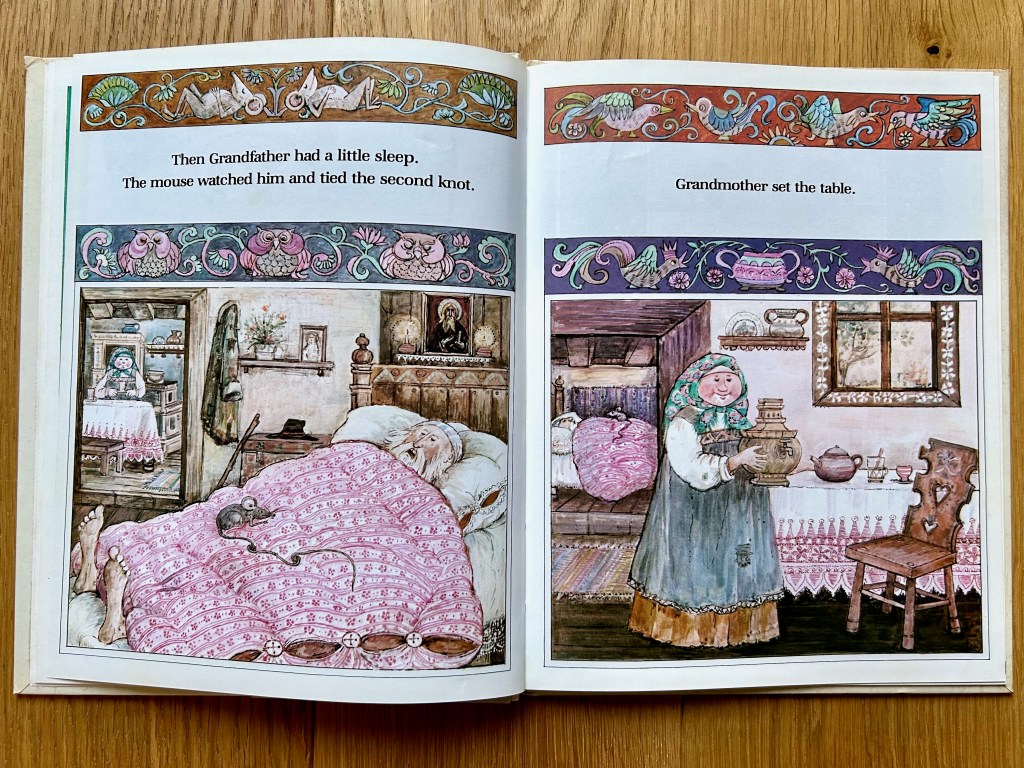
Grandfather is in bed under a pink duvet. The mouse sits on his belly. The grandmother can be seen in the other room. The right page shows the reverse situation where the grandmother is front and center setting the table and the grandfather is seen in the other room sleeping with the mouse on his belly.

Next up, Grandfather had a little sleep. The mouse is sitting on his tummy watching him sleep and “tied the second knot.” I really do think we are talking about a “strike 1, 2, 3” situation here. I hadn’t realized that until I sat to write this review. I reread the book aloud before beginning my review and was still pondering the meaning of the knots. But I’m pretty sure that is what is happening. I have no other reference to use but an American “3 strikes and you’re out” terminology which obviously would make no sense in a baseball-less culture like the UK. I cannot find any British explanation for the knot tying situation in my quick googling research but I am going to have to figure out a way to ask if this is a thing and where it comes from. How fascinating! A new layer to the book that I hadn’t discovered yet. See, this is why I come to discuss picture books here. No one else would hash out this book with me and help me come to these thoughts and conclusions! But I digress. Back to our story.

Grandfather is napping after his complaints. The mouse is watching. And Grandmother is in the kitchen setting the table. I find the decorative borders in this one worth pondering. The top one, the mouse is also seen (in double!) sleeping. Hm…. Then there are three owls, one with open eyes and two with closed. Then there are four birds having a discussion or something. And finally 2 birds possibly wearing crowns squawking at a fancy bowl.

I would also like to pause and point out that part of the lovely decorations in the house around them has often included 2 paintings on shelves in the background. One in the kitchen, has been seen twice, with a man who has a saint icon around his head and there are two lit candles on the shelves around him. The other painting is in the bedroom above the head of the sleeping grandfather. It is a different man also with a saint icon and he is holding something in his hands. Two candles are lit on the shelves around him as well.

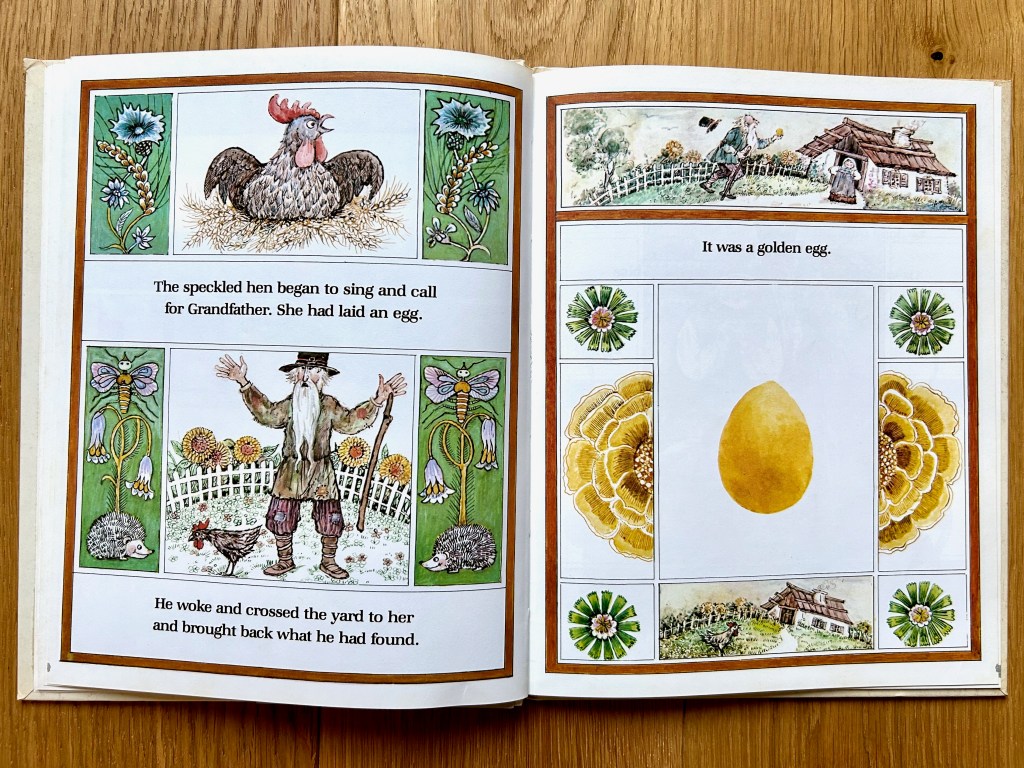
Left page, the hen sits calling on her roost. The grandfather is seen with hands spread in surprise. Right page the grandfather runs to the house with the golden egg. A golden egg sits large on the center of the page. The hen looks on.

Next we have the speckled hen singing from her roost, calling for Grandfather. “She had laid an egg.” How kind of her. How curious. What is to come? Grandfather wakes and goes to bring back what he had found. Grandfather looks excited or surprised or something. Two hedgehogs appear in the decorative borders around him and maybe it is just me, but they look like they are smirking.

“It was a golden egg.”

The golden egg takes center of the page on the right. It is possibly actual size on the page. It is framed mostly by 4 (green?) flowers and one very large yellow flower that is divided by the egg’s box.

A long panel on the top of the page shows the grandfather running back to the house with the golden egg in hand. He is losing his hat in the process. The grandmother looks unimpressed with hands still on her hips.

The bottom smaller panel on the page shows the hen standing in the garden looking at the house which has a closed door. Hm….

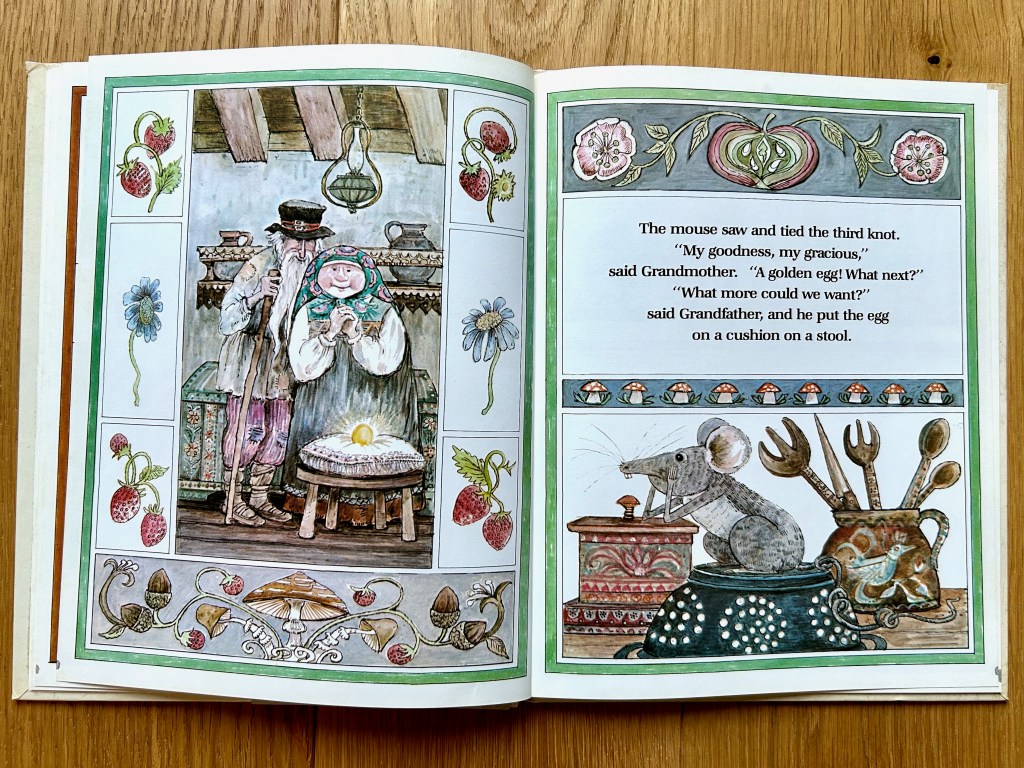
Left page, the grandparents stand together looking pleased at the golden egg on a pillow on a stool. They are bordered by fruits and flowers. Right page, the mouse has his head in his hands watching them with a third knot in his tail.

Now we have the grandfather (with recovered hat) and the grandmother with clasped hands looking down at the golden egg which they have placed on a cushion on a stool. The golden egg is glowing. The decorations around them are strawberries and flowers and a few mushrooms and acorns. No idea why. Abundance maybe? Deliciousness?

The mouse saw from the right page. He has tied the third knot. He is looking on a bit incredulously perhaps with his tiny paws holding his face and his elbows on a grinder. He is sitting on an overturned colander. Grandmother has exclaimed about the egg and asked “What next?”

And Grandfather says, “What more could we want?” He put the egg on the cushion and a stool.

Grandfather and grandmother look out two windows thinking. The hen looks disgruntled in a white box.

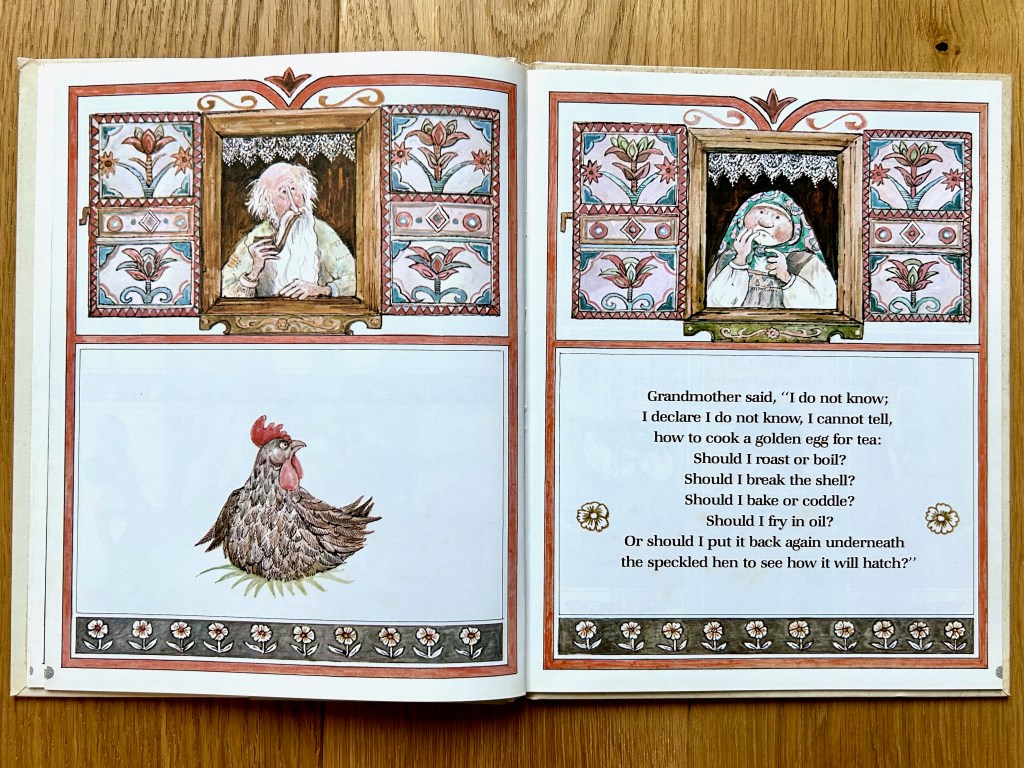
We have a great pause. From two separate, yet gorgeously decorated windows, the grandfather and grandmother look out. Both seem to be thinking. The grandfather has his pipe. The grandmother has her hands poised in thought. We see her thoughts in the text pondering how to cook a golden egg or if she should return it under the speckled hen to see how it will hatch.

The speckled hen sits in a startling white and undecorated space looking up towards the grandmother with an irate or disgruntled look if that is possible.

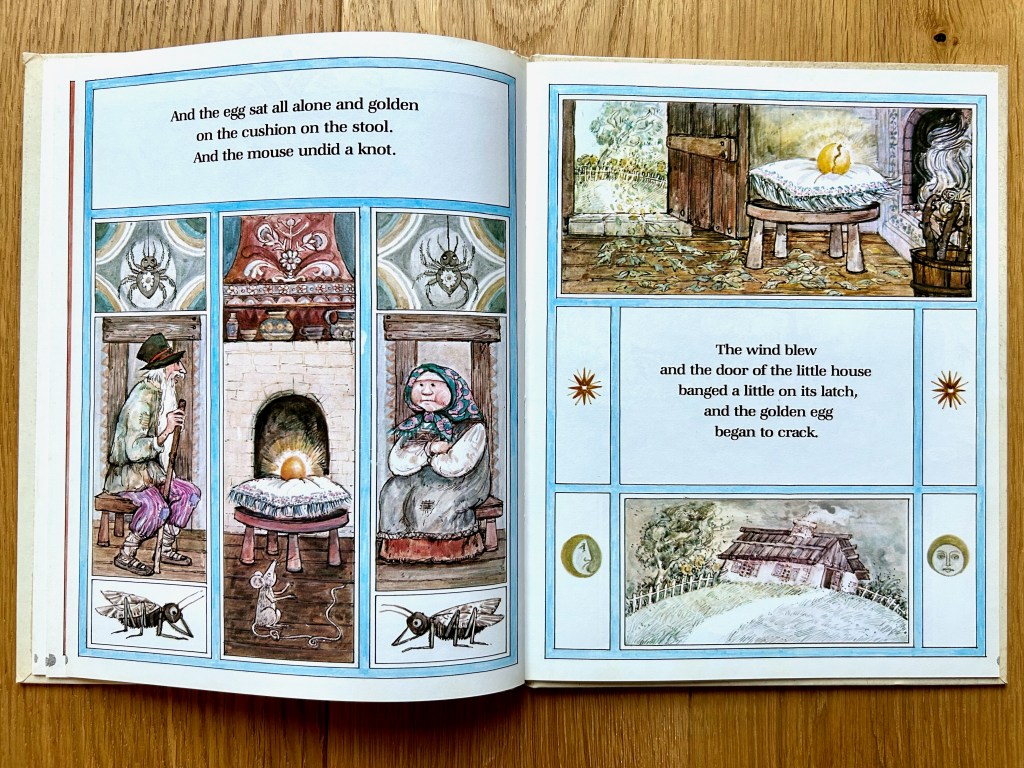
The three look on the egg sitting alone on the stool. And then the wind is blowing in and the sky has darkened and the egg is cracking.

Here we have a triptych-type layout. Three main panels. The center one holding the golden egg glowing on the cushion on the stool. The grandfather and grandmother flank the egg on either side. The grandfather’s mouth is open, but no text comes from him. The grandmother has her arms crossed. Two spiders sit above the grandparents’ panels, rolling their eyes? And two grasshoppers sit under their panels looking annoyed, or bored.

The mouse sits within the center panel looking up at the golden egg. We are told “the egg sat all alone and golden on the cushion on the stool. And the mouse undid a knot.” I’m not sure why. There is no undoing strikes in the American saying. Something is undoing the knots. Is it because it is alone? Is it because they are perplexed? Is it because it is unused?

On the right page, the wind blew the door of the house open. The golden egg began to crack. We also see a vignette of the house with the trees blowing in the wind and the sky is darkening. The house is framed on either side by odd faces, one turned and looking dissatisfied at the house. The other looking out at the reader, breaking the fourth wall.

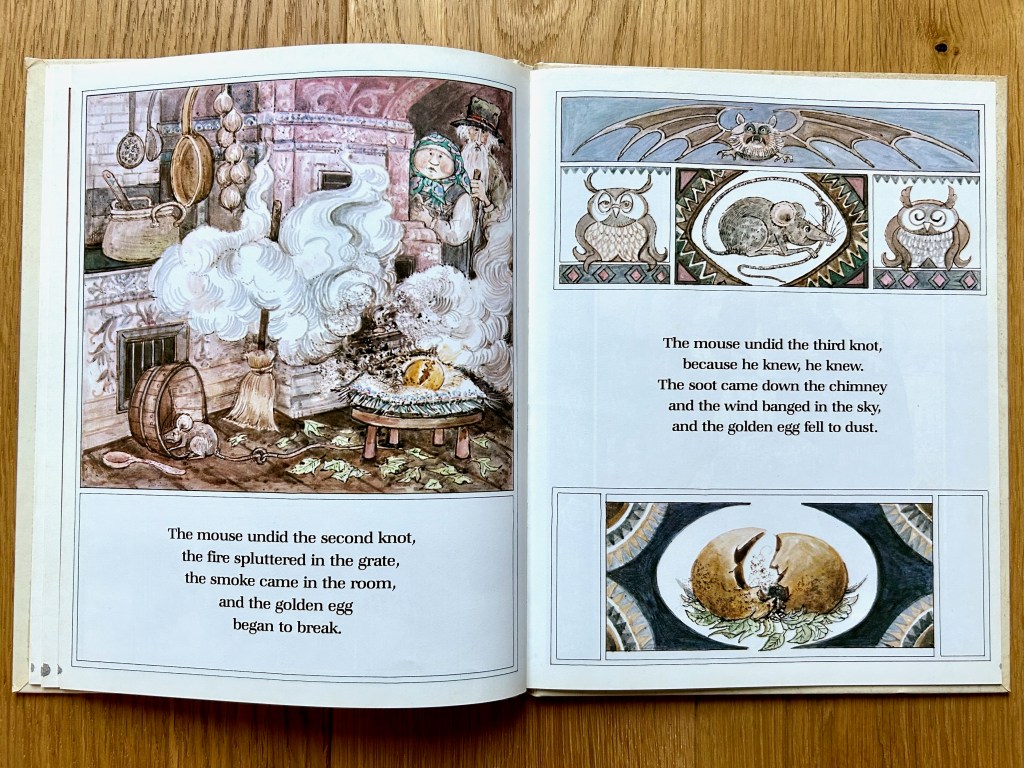
Left page is filled with smoke. The grandparents look on horrified. The egg is cracked open. Right page the mouse undid the last knot, and the egg is brown and smoldered into ash inside.

This page opens with “The mouse undid the second knot,” while the fire spits and smoke fills the room and the egg continues to break. We see the grandparents peering around the fireplace and the mouse is half hiding in a basket that has fallen to the ground. Leaves are all around the floor under the stool and ash is spilling onto the cushion and egg.

On the right page the mouse unties the third knot “because he knew, he knew.” What does he know?! At the top of the page a bat looks creepily out at the reader with its wings spread across the top of the page. Two owls flank each side of the mouse’s box, one owl looking out, the other with closed eyes and head downward. The mouse sits in the center almost smiling, holding his tail circled over him and unknotted. Is it almost over? He seems to think so.

At the bottom of the page, the golden egg sits now browned and cracked open with dust inside.

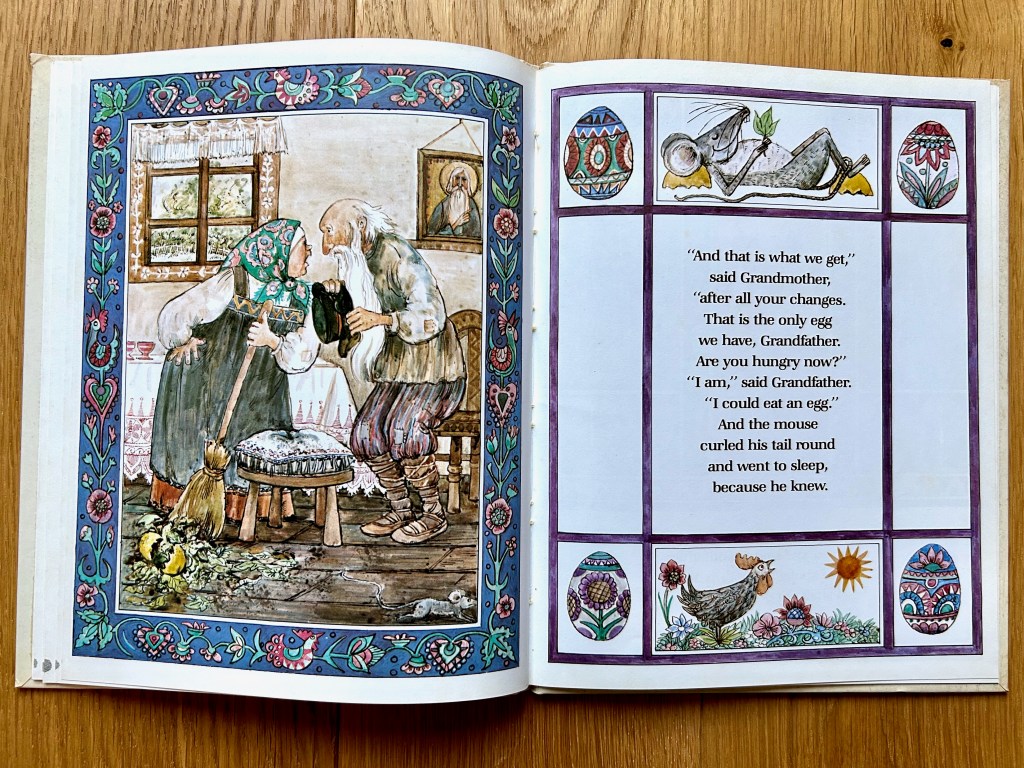
Grandmother is sweeping and shouting at grandfather who looks sheepish and hat in hands. Right page the mouse sleeps on his back looking content. The hen is crowing at the sun.

A large illustration fills the left page. The border is all around the page in blue with flowers and squawking hens and hearts. The grandmother holds a broom with one hand on her hip. She is turned with open mouth and furrowed brow clearly shouting at the grandfather. The grandfather looks at her very close to her face and looks sheepish, with his hat crumpled in his hands. The egg sits in a pile of ash and leaves on the floor. The mouse is running from the frame. And another saintly man is hanging on the wall pointing ever so slightly to the right page.

The right page is lots of white. Four beautifully painted eggs sit in the four corners. The mouse lays on his back in the top center, looking very content with eyes closed and a big smile. His head and feet are resting on the broken egg shells. And he is holding a green leaf.

In the center of the bottom, the speckled hen stands in a patch of flowers and squawks at the shining sun.

The grandmother’s words are harsh and pointed. “And that is what we get after all your changes. That is the only egg we have, Grandfather. Are you hungry now?”

“I am” said Grandfather. “I could eat an egg.”

And the mouse curled his tail round and went to sleep, because he knew.

I am baffled. What does he know? We can only guess. I love how his tail lays simple across his ankles.

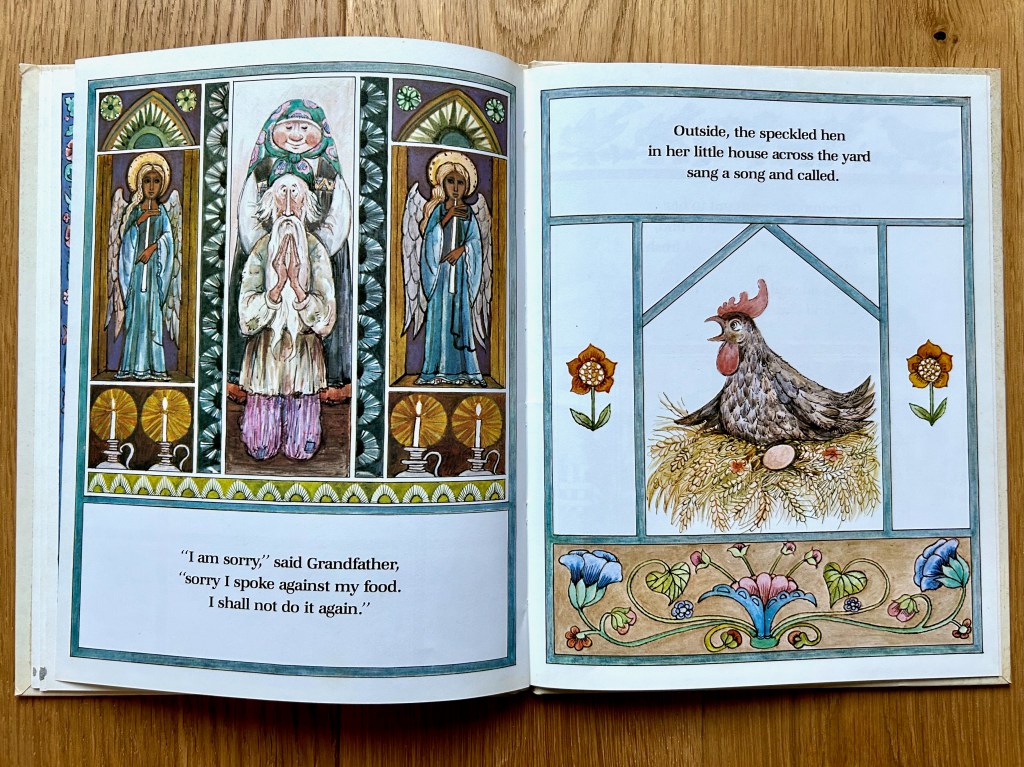
Three panels on the left with two angels in the side ones and the grandfather on his knees praying while the grandmother looks on. The hen sings from her roost about another egg on the right.

Another triptych on the left page. Three panels. The center panel is the grandfather on his knees praying while the grandmother stands smiling directly behind him. Two angels flank them in the side panels holding long white horns and four lit candles glow beneath them. Grandfather’s needed apology sits in the bottom box, apologizing for speaking against his food.

On the right page, the speckled hen is sitting in a lovely nest with a simple brown egg. She looks happy again. She is looking towards the praying pair on the left with beak open apparently singing a song and calling to them. Flowers bloom in borders around her.

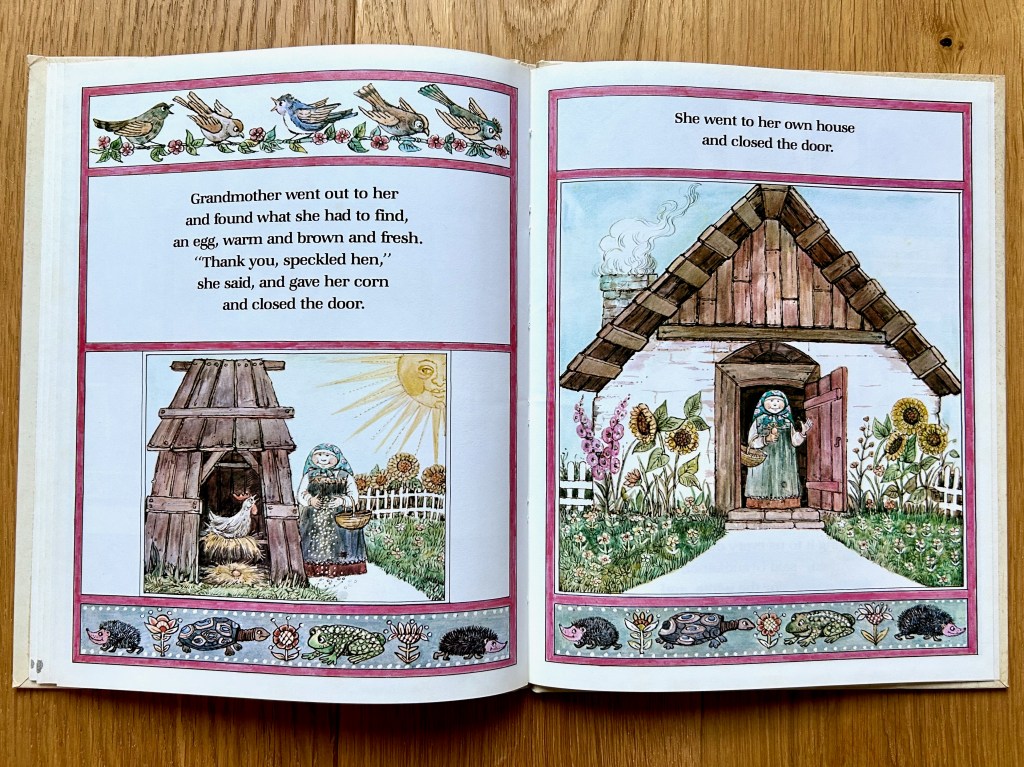
Grandmother goes to the hen house with a basket and the sun looks on. On the right she is standing in the doorway of her own house.

This time Grandmother goes to the hen house to find what she had to find. It was “an egg, warm and brown and fresh.” She thanks the speckled hen and gives her corn and closes the door. The sun looks on.

Birds decorate the top border. And the hedgehogs are back with a turtle and a frog in the bottom frames.

On the right, the grandmother stands in the doorway of her own house. It is a lovely looking house with sunflowers bold and blooming on each side of the door and smoke drifting from the chimney.

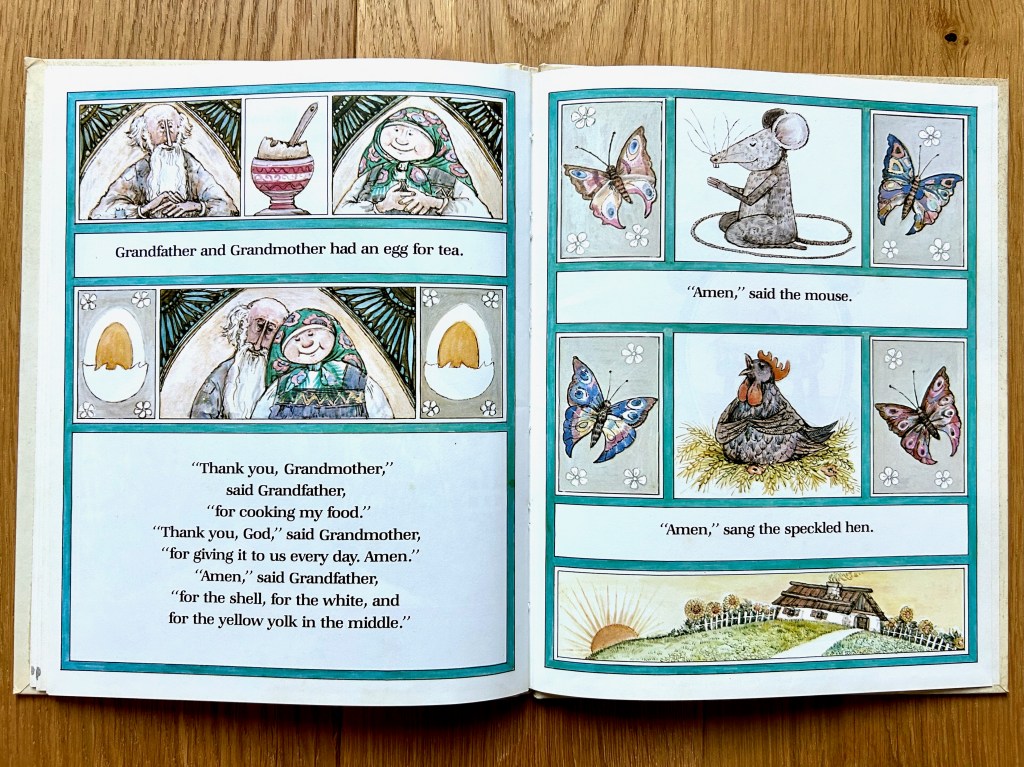
Grandfather and grandmother flank a cracked egg in an egg cup on the top left. They are smiling and leaning together with closed eyes underneath that. On the right, the mouse is kneeling and praying, the hen is singing, and the house looks lovely with the sun setting behind the hill.

“Grandfather and Grandmother had an egg for tea.”

(If this seems odd to my American readers, tea, in this case, is a light meal. Dinner is the heavy meal of the day whenever you have it. If you have dinner at noon, you have tea for the evening meal. You can also have tea to drink anytime. It’s confusing, but makes sense in the UK.)

The top of the left page is another smaller triptych. Half an egg sits in an egg cup in the center with a spoon coming out of it. Grandfather and Grandmother sit in the side boxes looking admiringly at the egg.

Underneath that is three more boxes. The center has Grandfather and Grandmother leaning into each other with soft smiles and eyes closed. Content. An interesting open egg, but fully intact hardboiled egg sits on either side of them.

The text holds their thanks. Grandfather says thank you to Grandmother for cooking his food. Grandmother says thank you to God for giving it to them every day. Grandfather echoes her Amen and adds “for the shell, for the white, and for the yellow in the middle.” He has learned.

On the right page, three segments of boxes stripe the page. The top, the mouse is kneeling, facing the left page, with eyes closed and hands in prayer. His tail circles him on the floor. Two butterflies float in boxes on either side. The mouse says “Amen.”

In the center line, the hen sits on her nest with wings in a prayer-like pose. Her head is upturned and her mouth is open singing “Amen.” Two butterflies float on either side of her.

The bottom stripe is one long, thin box. The house sits cheerily on its hill again, with the sun setting behind the hill. All is right again.

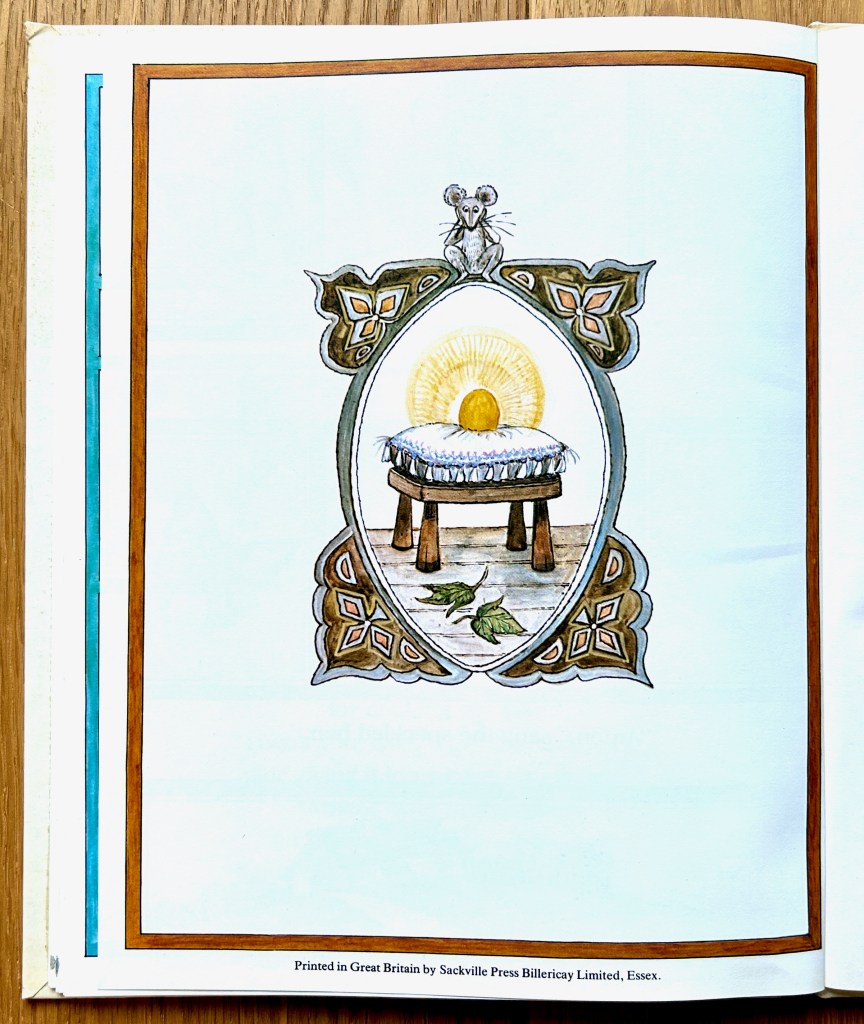
And the last page is the golden egg sitting on the cushion on the stool with two leaves on the floor. This vignette is framed decoratively in an egg-like oval and the mouse sits on the top center of it with his elbows resting on his knees and his face in his paws looking down at the egg. What an ending.


Well, if you made it through this review, congratulations and thanks for joining me in this intensely deep analysis of a crazy 1980s picture book. This is truly why I began this blog ages ago. Because no one ever wants to discuss picture books with me in the depth and obsessively passionate way I like. So thanks for reading if you did. I hope you enjoyed it and learned something along with me. I sure did. And I look forward to going back to my own work now, creatively refreshed and inspired. Until next time and our next book!


Final note/disclaimer: Upon finishing writing this review, I was doing my usual spell-checking and adding links where needed when I came across startling information about the book’s author, William Mayne. I was completely unaware of his conviction. I am disheartened and saddened by the information. I mulled over what this means for his books. I can’t say how I would have approached this book’s discovery were I familiar with him previously. But as I chew on the information, I read some articles about him and had a good think. Overall, I think lots of beloved children’s authors have sordid histories and I’m not sure anyone has decided how to handle them. Can we distinguish between the person and the imaginative work? Is the person defined by their worst decisions? Are we all? I think it is a case-by-case basis and left to conscience. So, I still admire this book and will continue to read it, but I leave it to you reader to make your own decision about Mayne’s works. In this case especially, I don’t think the text is the clear star anyway. The illustrations take the cake without a doubt! So, what’s the history behind this book. Was it solely Mayne’s genius or likely we should look to and celebrate Krystyna Turska more? Ah, the ever-present argument and question behind collaborative picture books. A discussion for another post and another time perhaps, and best offline. Here are some of the articles I found helpful to learn more about Mayne’s incredible portfolio of work and accolades as well as others who wrestled with this issue when it happened 20 years ago: Mayne’s obituary in the Guardian. An article in The Independent. A Guardian opinion piece.

If you are wrestling with the author, or even if you aren’t, I highly recommend focusing much more on the illustrator, Krystyna Turska. She carried this book to incredible places and made it what it is. And her life and work is 100% worth investigating and admiring.

With the best intentions for honesty and transparency, thanks for reading. – Caryn

March 5, 2025November 17, 2025

CarynLeave a comment

Vintage Friday: How My Parents Learned To Eat By Friedman & Say

When I was writing about Monday’s book and thinking of Japan and cultural differences, this book came to mind. I love this book. Monday we talked about a Japan bath house. For this vintage Friday, I bring a love story about ways of eating. Whether you eat with chopsticks or use utensils the American way or the British way, you’ll love this story. Take a look at How My Parents Learned to Eat by Ina R. Friedman, illustrated by Allen Say, 1984.

Continue reading “Vintage Friday: How My Parents Learned To Eat By Friedman & Say” →

June 17, 2022June 20, 2022

CarynLeave a comment

Let’s Read Three: Vintage Valentine’s Day Books!

While I’m not one to collect many Valentine’s themed books, I couldn’t help but grab a few pictures of three of my favorite vintage Valentine books. These books are harder to find but you know I love a good trio, and these three are all quite different in their approach to this holiday. Let’s read three (vintage) books about Valentine’s Day!

Continue reading “Let’s Read Three: Vintage Valentine’s Day Books!” →

February 14, 2018January 30, 2024

Caryn2 Comments

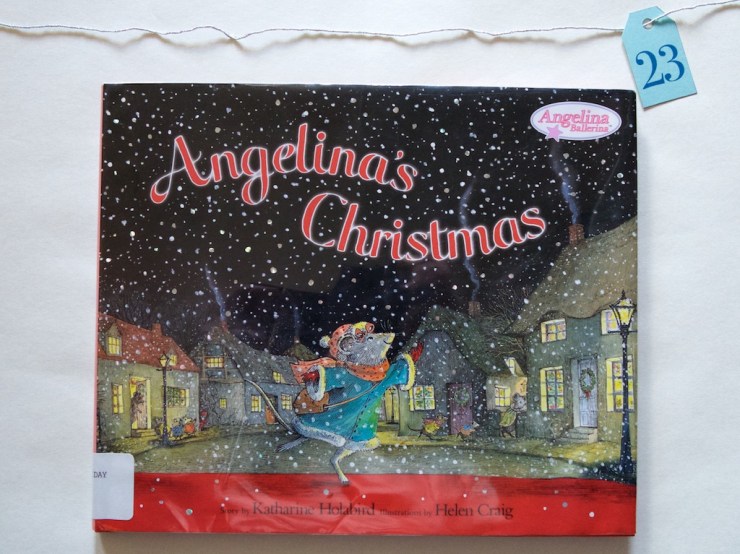
25 Days – Book 23: Angelina’s Christmas

Day 23 is here and in all the hustle and bustle of finishing out the season, it is a good time to stop and think about those who have no one to share the holiday with. For this there is a book like Angelina’s Christmas by Katharine Holabird, illustrations by Helen Craig, 1985.

Continue reading “25 Days – Book 23: Angelina’s Christmas” →

December 23, 2017April 18, 2020

CarynLeave a comment

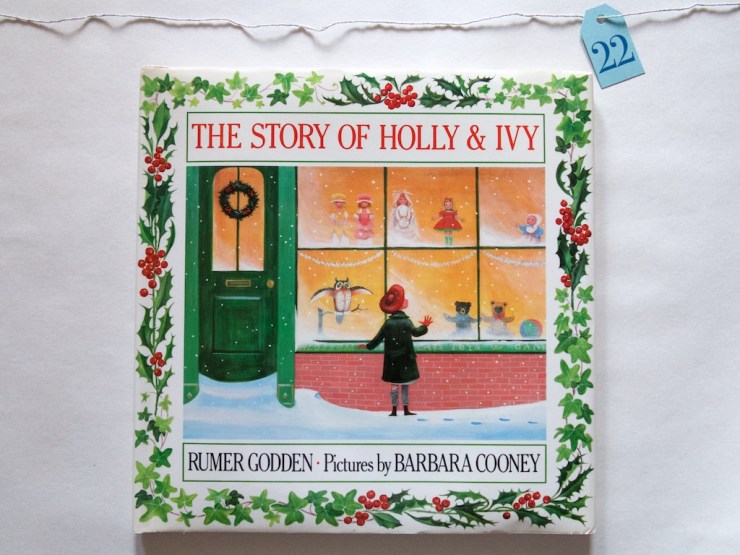
25 Days – Book 22: The Story of Holly & Ivy (Cooney)

Day 22 has arrived and with it a long, lovely picture book. There have been many illustrated versions of this picture book. I have two of them: one illustrated by one of my favorites, Adrienne Adams, and this one. This is the one that I have very specific memories of from childhood. I don’t remember owning this book. It must have been a favorite from the library. But I remember the pictures like I made them myself. They bring a flood of memories. And someone must have read me the story, or perhaps I could read for myself at the time; but this one leaves an impression on your heart. Come enjoy a story about wishing. This is The Story of Holly & Ivy by Rumer Godden, pictures by Barbara Cooney, 1957/1985.

Continue reading “25 Days – Book 22: The Story of Holly & Ivy (Cooney)” →

December 22, 2017April 18, 2020

Caryn3 Comments

Posts navigation

Older posts

About

Hello. I’m Caryn, passionate obsessor of children’s picture books and an illustrator. This is where I share my ever-growing knowledge and love of children’s books. I’ll be reviewing books, sharing tips, and hopefully convincing the world of the loveliness of picture books.

Read more…

Recent Posts

  • Review: The Man Who Loved Books By Fritz & Schart Hyman
  • Blogger ghosting issues
  • 12 Days – Book 2: Saint Nicholas the Giftgiver
  • 12 Days – Book 1: Ink the Cat’s Christmas
  • 12 Days of Children’s Christmas Books

Categories

  • Book Reviews(343)
  • Book Trailers(21)
  • Featured(1)
  • How To's(12)
  • Illustration Loves(2)
  • Lists(44)
  • News & Links(29)
  • Quotes(28)
  • Videos(6)

Processing…
Success! You're on the list.
Whoops! There was an error and we couldn't process your subscription. Please reload the page and try again.

Follow

  • Instagram

Menu

  • Home
  • About
  • Review Policy
  • Contact
  • Subscribe Subscribed
    • Three Books a Night
    • Already have a WordPress.com account? Log in now.
    • Three Books a Night
    • Subscribe Subscribed
    • Sign up
    • Log in
    • Report this content
    • View site in Reader
    • Manage subscriptions
    • Collapse this bar
 

Loading Comments...